Worked example · Mathematics
Finding an angle, and why the calculator gives you only one
A right-angled triangle with a 7 cm side opposite the angle and a 12 cm hypotenuse. What is the angle? SOHCAHTOA and the inverse sine key answer it in one line — and then hand back a single number where the equation has infinitely many. This page finds the angle, shows the answers the calculator left out, and finishes with a triangle that has no right angle at all.
SOHCAHTOA: choosing the right ratio
Label the triangle from the angle you want. The hypotenuse is the long side facing the right angle; the opposite faces your angle; the adjacent is the one left over. Here you have the opposite (7 cm) and the hypotenuse (12 cm), so of the three ratios only one uses both:
That gives the sine of the angle, not the angle. To go backwards from a ratio to an angle you need the inverse — sin⁻¹, the SHIFT function of the sin key. Check the display says DEG first:
- SHIFT
- sin⁻¹
- 7
- ÷
- 12
- )
- =
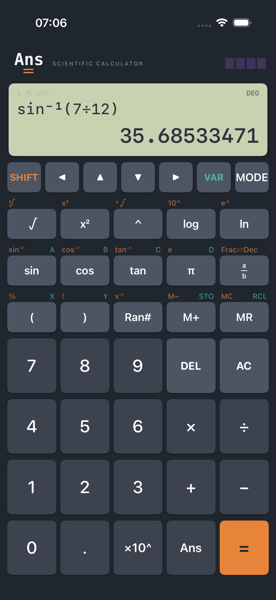
Divide inside the bracket, not before it. Typing 7 ÷ 12 first and then taking sin⁻¹ of the answer gives the same number here — but the moment the ratio is part of a longer expression, the bracket is what keeps the division underneath the inverse rather than beside it.
The equation has more answers than the key gives back
Ask the question without the triangle — solve sin θ = 0.5833 — and 35.69° is only the first answer. The sine of an angle repeats: it rises to 1 at 90°, comes back down through the same values, and then does the whole thing again every 360°. Plot both sides and the extra answers are simply there to be counted:
f₁(x) = sin(x) f₂(x) = 0.5833333333
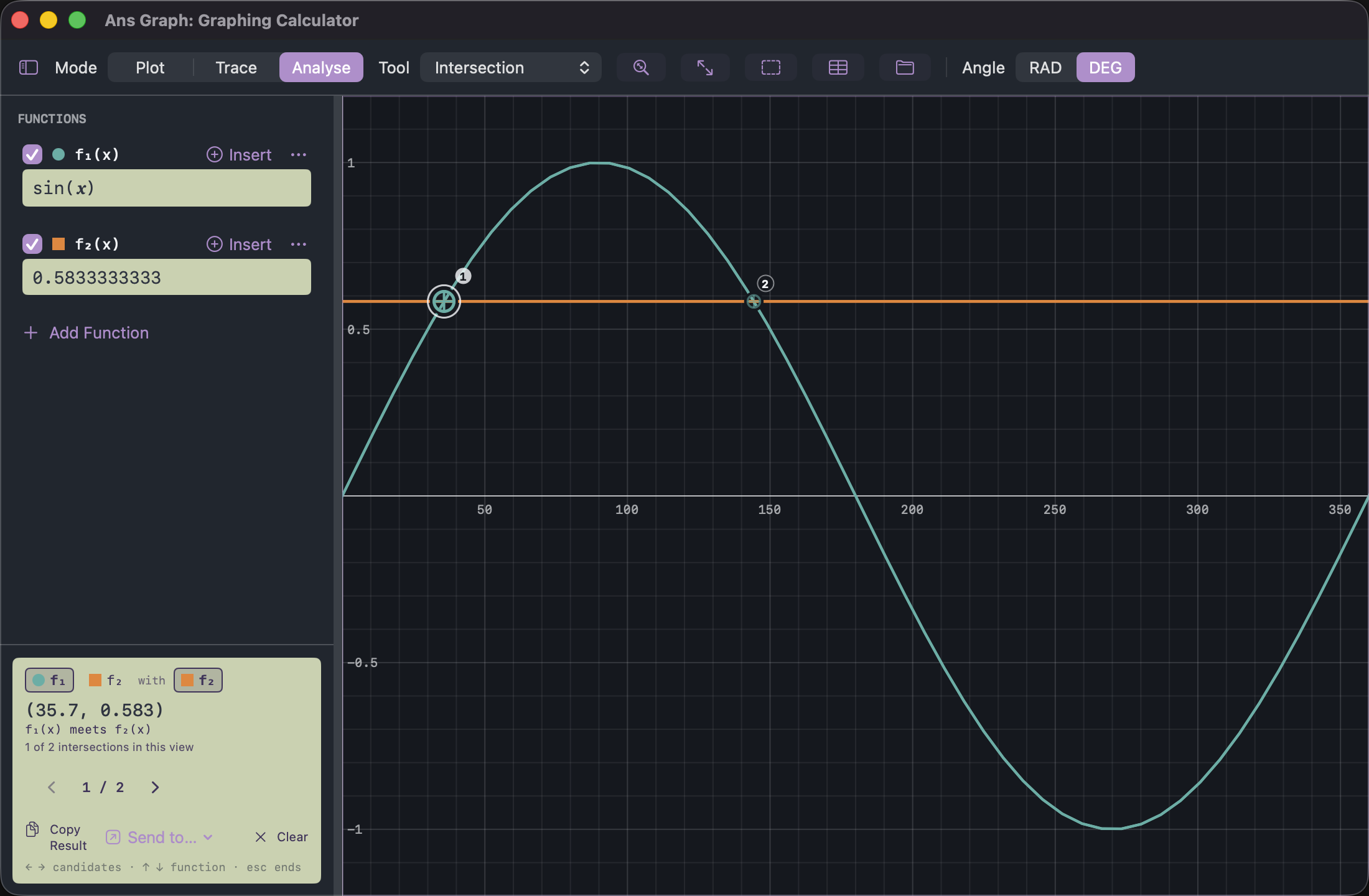
The second one is 180° − 35.69° = 144.31°, and you can see why from the shape: the sine curve is symmetric about its peak at 90°, so every value below 1 is reached once on the way up and once on the way down. Widen the window to 720° and there are four crossings; keep going and there is no end to them.
In a right-angled triangle the second answer is discarded, because an angle of 144.31° will not fit alongside a right angle. That is a fact about the triangle, not about the equation — and when the same trigonometry turns up in waves, oscillations or bearings, the discarded answer is often the one you needed.
Why the key can only give one. sin⁻¹ has to be a function: one input, one output. Since sine takes the value 0.5833 infinitely often, the inverse is defined to return just the angle between −90° and 90° — the principal value. It is a convention that makes the key usable, not a statement that the other answers do not exist.
The cosine rule, when SOHCAHTOA does not apply
SOHCAHTOA needs a right angle. Take a triangle with sides 5, 7 and 8 and no right angle anywhere, and all three ratios are useless — there is no hypotenuse to divide by. The cosine rule works on any triangle:
- C is the angle you want · c is the side facing it · a and b are the other two, in either order
Getting that pairing right is the whole difficulty, so put the sides in variables and let the letters carry it. To find the angle facing the 8 cm side, that side is c:
- 5
- VAR
- STO
- A
- 7
- VAR
- STO
- B
- 8
- VAR
- STO
- C
The calculator now holds
- A
- 5
- one side beside the angle
- B
- 7
- the other side beside it
- C
- 8
- the side facing the angle — the one that must go on its own
Now the rule reads exactly as it is written, with cos⁻¹ on the SHIFT layer of the cos key:
- SHIFT
- cos⁻¹
- (
- VAR
- A
- x²
- +
- VAR
- B
- x²
- −
- VAR
- C
- x²
- )
- ÷
- (
- 2
- VAR
- A
- VAR
- B
- )
- )
- =
Just under a right angle, which is what a 5-7-8 triangle looks like: had the third side been exactly √74 ≈ 8.60, the angle would have been 90° and Pythagoras would have applied. The cosine rule is Pythagoras with a correction term — when C = 90°, cos C = 0 and the last term vanishes.
cos⁻¹ has no second answer to lose. Between 0° and 180° — every angle a triangle can contain — cosine takes each value exactly once, so the inverse is unambiguous. It is the sine rule that suffers here: given a side and its opposite angle it can return either an acute or an obtuse answer, and both may fit the triangle. Prefer the cosine rule when you have the choice.
This triangle shows it happening. Having found C = 81.79°, the sine rule gives the angle facing the 7 cm side as sin B = (7 × sin C) ÷ 8 = 0.8660254038, and sin⁻¹ of that is 60° — but 180° − 60° = 120° has the same sine, and nothing in the sine rule chooses between them. Only the angle sum does: 120° would leave −21.79° for the third corner, which no triangle can have. The cosine rule never asks the question, because cos B = (5² + 8² − 7²) ÷ (2 × 5 × 8) = 0.5 gives 60° and only 60°. The sine is ambiguous; the cosine is not.
The angles on this page
| Question | Expression | Answer |
|---|---|---|
| Angle from opposite 7, hypotenuse 12 | sin⁻¹(7÷12) | 35.68533471° |
| The other solution in 0°–360° | 180 − 35.68533471 | 144.3146653° |
| Adjacent side, by Pythagoras | √(12²−7²) | 9.746794345 cm |
| Angle facing the 7 cm side of a 5-7-8 | cos⁻¹((5²+8²−7²)÷(2×5×8)) | 60°, exactly |
| Angle facing the 8 cm side of a 5-7-8 | cos⁻¹((5²+7²−8²)÷(2×5×7)) | 81.7867893° |
What to watch
- The angle unit is part of the question, not a preference. Everything here is DEG; in RAD the same keystrokes give 0.6227 and 1.4274 instead, and both are correct answers to a different question.
- SOHCAHTOA applies only to right-angled triangles. With no right angle you need the sine or cosine rule, whatever the sides look like.
- sin⁻¹ and tan⁻¹ return the principal value only. Where the context allows an obtuse angle — waves, bearings, anything periodic — the second solution has to be found by hand or by looking at a graph.
- sin⁻¹ of anything above 1 is a Math ERROR rather than a large angle: a ratio greater than 1 means the "opposite" side has been given as longer than the hypotenuse, which no triangle allows.
- Rounding an angle and then using it in the next step is how a two-stage triangle problem drifts. Keep the full display value in Ans, or store it.
Next: projectile motion, where an angle you choose decides how far the throw goes.
- Free
- No ads
- No tracking
- No account
- Every sum shown in full
Worked on Ans — a scientific calculator you can own and Ans Graph. Both keep the angle unit on screen, because it changes the answer.