Worked example · Physics
Projectile motion: the range formula, and where it stops working
Throw something at 20 m/s at 40° above the horizontal. How far does it go? There is a formula for that, and it is exact — for a projectile that starts and finishes at the same height. Nobody throws from ground level. This page does the textbook case, plots the actual flight, and then raises the launch point by two metres, which breaks the symmetry the formula depends on.
The textbook case: level ground, no air
Split the launch into two independent motions. Horizontally there is no force, so the speed stays at u cos θ. Vertically there is gravity, so the projectile rises, stops and falls exactly as it would if thrown straight up. The two are linked only by sharing a clock.
Landing back at launch height takes t = (2u sin θ) ÷ g, and multiplying by the horizontal speed gives the range:
- u launch speed · θ angle above the horizontal · g 9.81 m s⁻² · R range on level ground · H greatest height above the launch point
Set the calculator to DEG and take the range first:
- 20
- x²
- sin
- 80
- )
- ÷
- 9.81
- =
The same two lines give H = 8.4236 m and a flight of 2.6209 s. And because sin(2θ) is symmetric about 90°, 40° and 50° give exactly the same range — which is the first hint that this formula is describing a very particular, very tidy situation.
Plotting the trajectory rather than its endpoints
The formula gives two numbers. The path itself is a parabola, and you get it by eliminating time between the horizontal and vertical motions:
With u = 20, θ = 40° and g = 9.81 there are two numbers to work out, and both are one line on the calculator in DEG: tan(40) = 0.8390996312 for the first coefficient, and 9.81÷(2×20²×cos(40)² ) = 0.02089638144 for the second. Ans Graph works in radians or degrees like the calculator, so either type the trigonometry with the angle unit set to DEG, or — as here — enter the two coefficients you have just worked out, which keeps the plot honest about what it is:
f₁(x) = 0.8390996312x-0.02089638144x^2
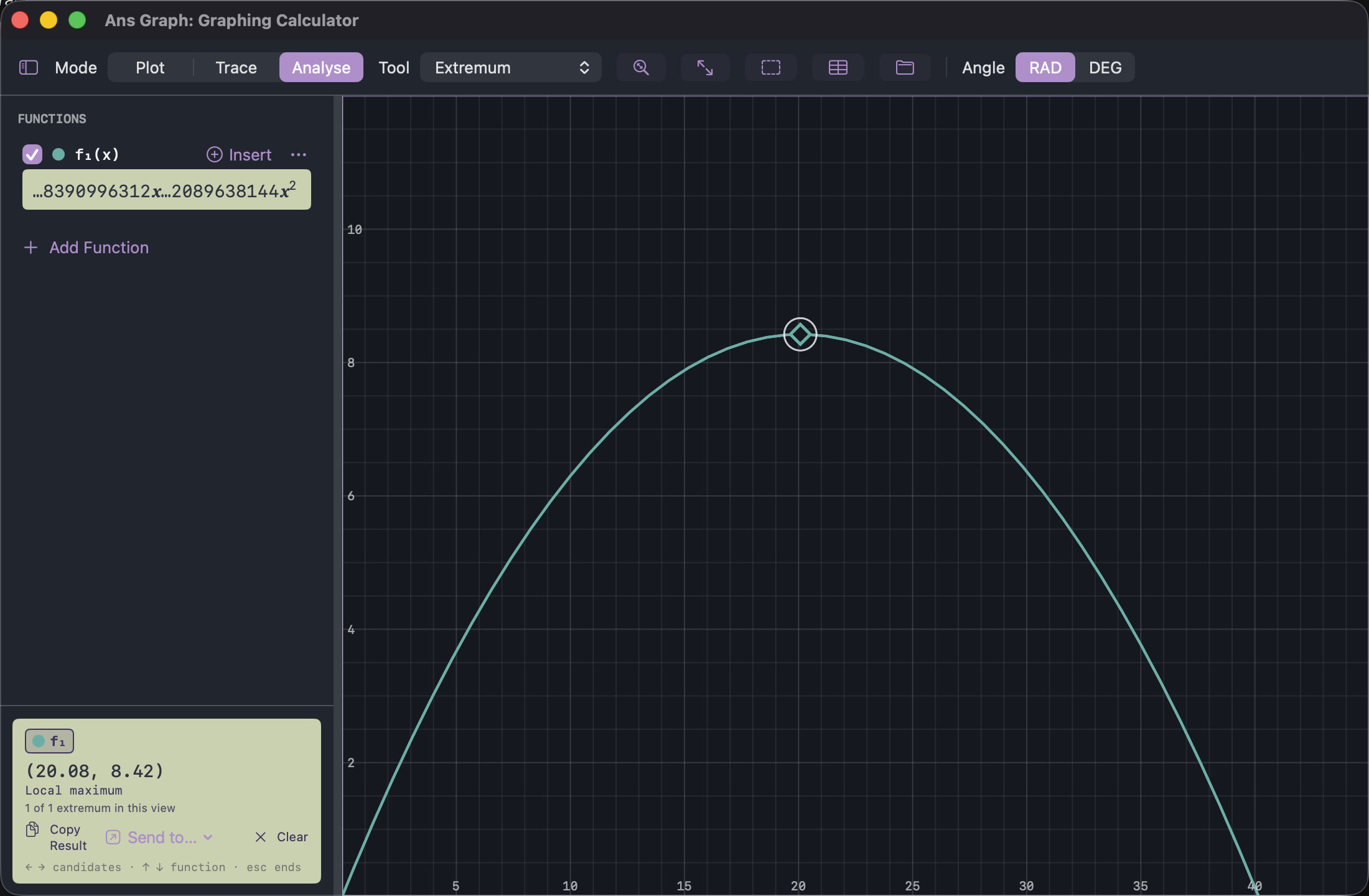
Root then finds where it lands: 40.16 m, with the other root at the origin where it was thrown. Two analysis tools, two numbers that already agreed with the algebra — which is the point of doing it twice.
The apex is at half the range only because the ground is level. Symmetry is doing a lot of quiet work in the textbook case: same height up and down, same speed at launch and landing, apex exactly halfway. Every one of those is about to stop being true.
Two metres up, and the formula is wrong
Nobody launches from the floor. Throw the same 20 m/s at 40° from 2 m above the ground and the projectile no longer lands at its launch height, so R = u²sin(2θ)/g does not apply — it answers a different question. The trajectory is the same curve lifted by 2:
f₂(x) = 2+0.8390996312x-0.02089638144x^2
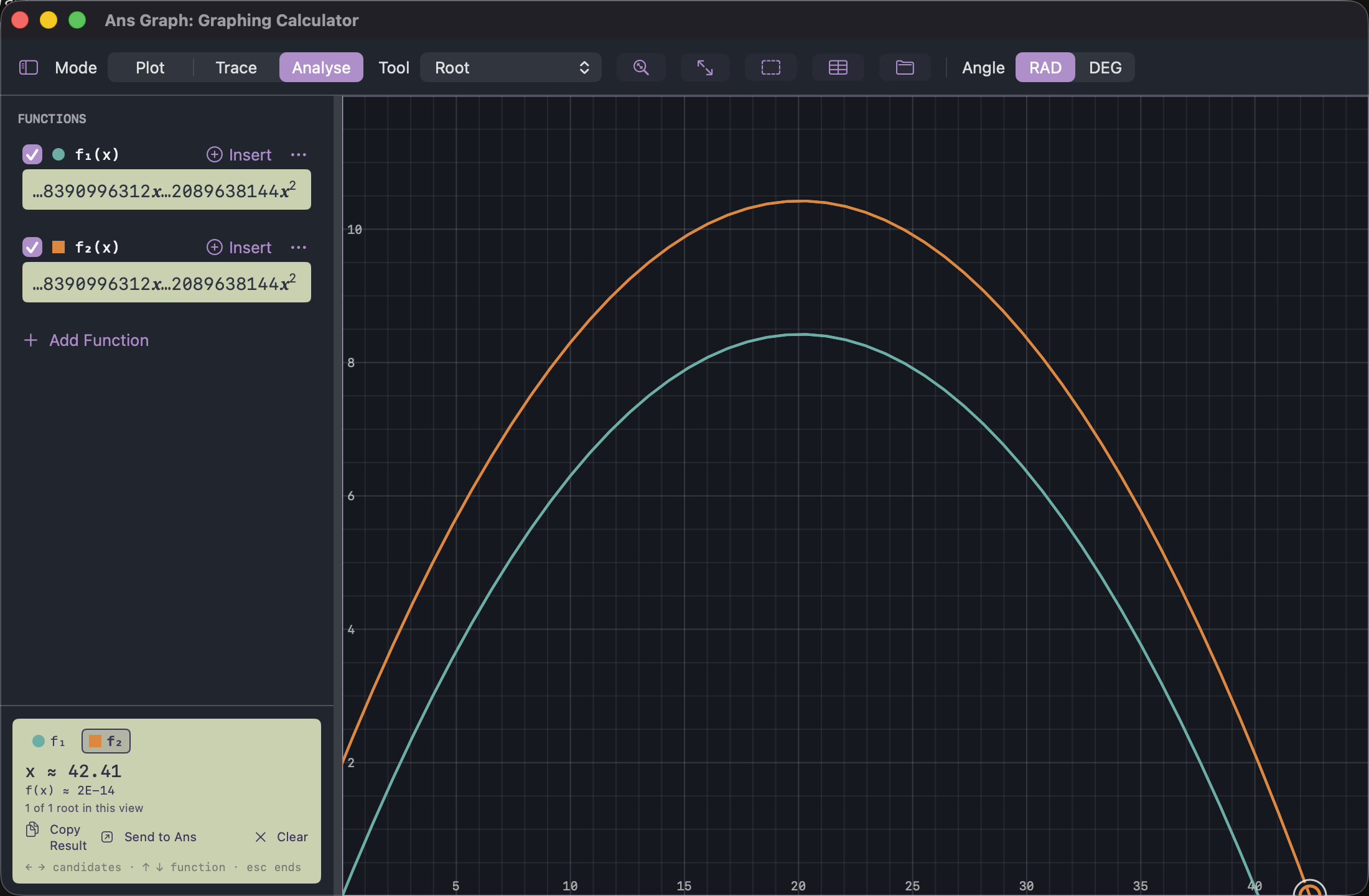
42.41 m against 40.16 m: two metres of launch height buys 2.26 m of range, more than the height itself. The apex is now 10.42 m above the ground and no longer sits halfway along; the descending half is longer than the climbing half, and the projectile is travelling faster when it lands than when it left.
There is a closed form for this case too — it is the positive root of a quadratic in x, exactly as on the quadratics page. But the graph gives it without the rearrangement, and gives it as a picture that makes the asymmetry obvious rather than something to be taken on trust.
The optimum angle, and how little it matters
On level ground the greatest range comes at 45°, because sin(2θ) peaks there. Launch from a height and the best angle drops — it pays to spend less of your speed going up, since the extra height is already given to you:
With u = 20 and h = 2 that is 43.66°, not 45°. But here is the part worth knowing, and the reason to have the numbers rather than the rule:
| Angle | Range | Against the best |
|---|---|---|
| 40° | 42.41 m | −0.32 m |
| 43.66° (optimum) | 42.73 m | — |
| 45° (the rule of thumb) | 42.69 m | −0.04 m |
The optimum is worth four centimetres over the textbook 45°. The curve of range against angle is almost flat near its peak, so the precise angle barely matters — while the two metres of launch height was worth 2.26 m. A model tells you which of its inputs deserve your attention, and this one says: worry about the height, not the angle.
What is really missing is the air. Every number on this page assumes a vacuum. A real ball at 20 m/s loses range to drag — noticeably for a light ball, less for a shot — and drag also pulls the best angle down further, typically into the mid-thirties for a thrown ball. The speed–time example shows what drag does to a much simpler motion; adding it here turns a formula into a numerical simulation, which is a different kind of page.
Both throws, side by side
| From the ground | From 2 m up | |
|---|---|---|
| Range | 40.16 m | 42.41 m |
| Apex above the ground | 8.42 m | 10.42 m |
| Apex at | half the range | before half |
| Best angle | 45° | 43.66° |
| Found by | formula | a root on the graph |
What this model ignores
- No air resistance at all. This is the big one: a real throw falls short of these figures, and the lighter the object the further short.
- No spin, so no lift or swerve — a struck or thrown ball with spin does not follow this curve.
- Gravity is a constant 9.81 m s⁻² acting straight down, and the ground is flat and level.
- The projectile is a point. Its size, and where on it you measure the launch height, are ignored.
- The range formula in step 1 applies only when the projectile lands at its launch height. Step 3 is not a correction to it — it is a different calculation.
Next: the inverse-square law for another physical model shaped by geometry, photon energy from wavelength, or area under a speed–time graph.
- Free
- No ads
- No tracking
- No account
- Every sum shown in full

Worked on Ans — a scientific calculator you can own and Ans Graph, whose Root and Extremum tools did the work the formula could not.