Worked example · Money
Mortgage repayments: where the money actually goes
£200,000 borrowed at 4.5% over 25 years. The lender quotes £1,111.66 a month. Where does that number come from, why does ten years of paying it clear less than a third of the debt, and what does stretching the term to 30 years really cost? One formula answers all three, and the shape of the balance curve answers the second one before the arithmetic does.
Where the mortgage repayment formula comes from
Two things happen every month, in this order: the debt grows by one month's interest, and then your payment comes off it. After n months the original debt has grown to P(1+i)n, and each payment has been sitting there growing too — the first for n−1 months, the last for none. The payments form the same geometric series that appears in compound interest with regular contributions, and by the final month the two must cancel exactly.
Setting them equal and rearranging for the payment gives:
- M the monthly payment · P the amount borrowed · i the monthly interest rate · n the number of monthly payments
The two conversions people get wrong. The rate must be monthly: 4.5% a year is i = 0.045 ÷ 12 = 0.00375. And the term must be in months: 25 years is n = 300, not 25. Put a yearly rate against a monthly term and the answer will look plausible and be nonsense.
Working out the monthly payment
The awkward part of this formula is that (1+i)n appears twice, once on each side of the fraction. So work it out once and keep it. Two things go into variables — the monthly rate, because it is the assumption you will want to change, and that repeated power, because it is the arithmetic you do not want to type twice:
- 0.00375
- VAR
- STO
- A
Now (1+A)300 into B. STO works out the line it is given, so this needs no equals of its own:
- (
- 1
- +
- VAR
- A
- )
- ^
- 300
- VAR
- STO
- B
The calculator now holds
- A
- 0.00375
- the monthly interest rate — 4.5% ÷ 12
- B
- 3.073742528
- (1+A)300, the part that appears twice
With both stored, the formula fits on the line looking like the formula:
- 200000
- ×
- VAR
- A
- ×
- VAR
- B
- ÷
- (
- VAR
- B
- −
- 1
- )
- =
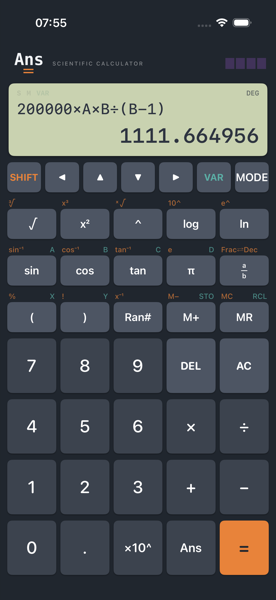
The two totals that follow are one keypress each, because the payment is still in Ans: Ans × 300 = gives £333,499.49 paid altogether, so the interest is £133,499.49 — two thirds of the house price over again, handed over for the privilege of not paying for it at once.
Because the assumption lives in A, trying a different deal means storing a new rate and pressing ▲ twice — once to rebuild B, once for the payment. That is the whole reason to use variables rather than type 0.00375 four times: the model stays put on the screen and the assumption moves underneath it.
Why ten years of payments barely dents it
The single number £1,111.66 hides the thing worth knowing, which is how the debt actually falls. After x months, what is left is the grown debt minus the grown payments:
Typed into Ans Graph, with the months along the bottom:
f₁(x) = 200000×1.00375^x−1111.66(1.00375^x−1)/0.00375
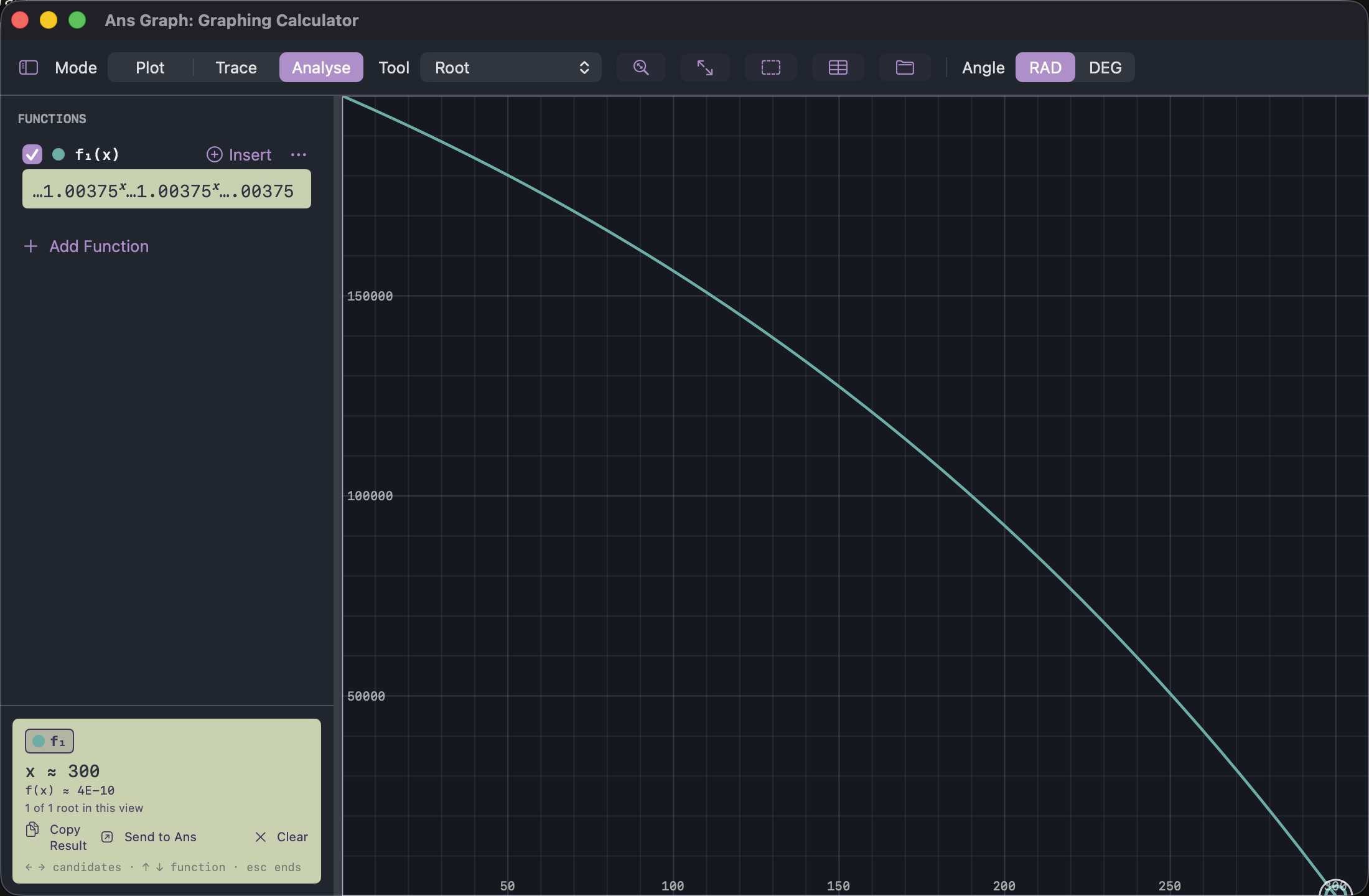
Trace to month 120 and the balance still reads £145,317.70. Ten years in — £133,399 handed over — and only 27% of the debt has gone. Early payments are mostly interest because interest is charged on a balance that is still almost the whole loan; only as the balance falls does more of the same £1,111.66 start biting into the capital. That is the curve's shape, and it is the argument for overpaying early rather than late.
Where the root lands, and why it isn't exactly 300. Paying the real £1,111.664956 clears the debt at month 300 to the penny. Paying the rounded £1,111.66 leaves about £2.74 outstanding, so the plotted curve crosses zero a fraction of a month later. That is not a rounding error in the graph — it is what rounding your payment down actually does, and the app is showing it rather than tidying it away.
What five more years costs
Stretching the same £200,000 over 30 years means n = 360. Nothing new to store and nothing to retype: press ▲ back to the line that built B, change the 300 to 360, and run the payment again.
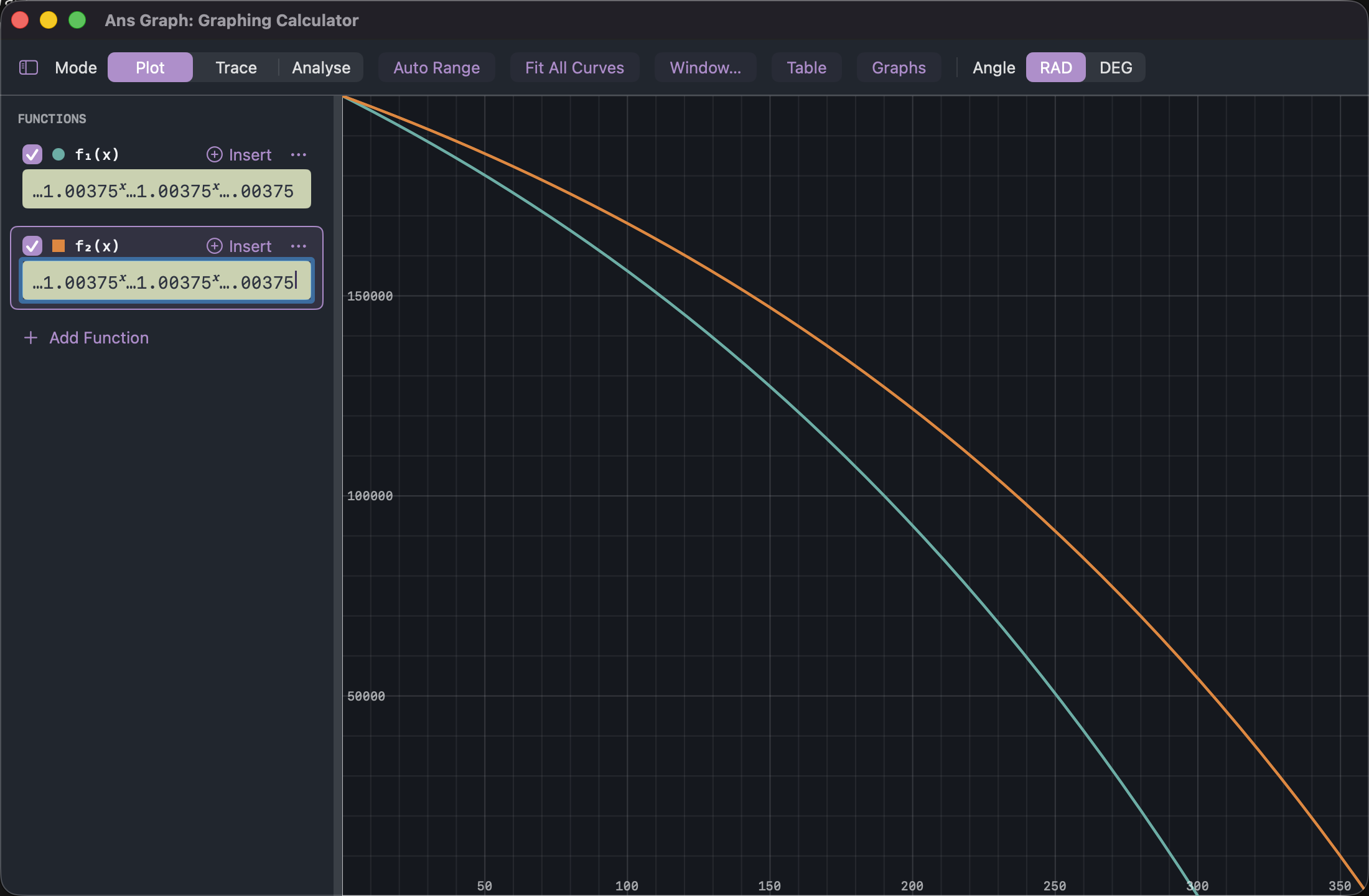
Then plot both balances together and the trade is visible in one picture:
f₂(x) = 200000×1.00375^x−1013.37(1.00375^x−1)/0.00375
| 25 years | 30 years | |
|---|---|---|
| Monthly payment | £1,111.66 | £1,013.37 |
| Payments made | 300 | 360 |
| Total paid | £333,499.49 | £364,813.42 |
| Interest | £133,499.49 | £164,813.42 |
Saving £98.29 a month costs £31,313.93 in extra interest. Whether that is worth it is not a mathematical question — money now is genuinely worth more than money later, and a payment you can definitely afford beats one you cannot. But it should be a decision made with the £31,313.93 in front of you, which takes about ninety seconds to work out.
The balance, five years at a time
| Month | Years in | Balance | Cleared |
|---|---|---|---|
| 0 | 0 | £200,000.00 | 0% |
| 60 | 5 | £175,716.14 | 12% |
| 120 | 10 | £145,317.70 | 27% |
| 180 | 15 | £107,265.07 | 46% |
| 240 | 20 | £59,630.94 | 70% |
| 300 | 25 | £2.74 | 100% |
What this model ignores
- One fixed interest rate for the whole term. Almost no UK mortgage works this way — a fixed period is followed by a reversion rate, and the payment is recalculated then.
- A pure repayment mortgage with no fees, no overpayments, no payment holidays and no early-repayment charges.
- Interest compounded monthly on the outstanding balance. Some lenders calculate daily, which changes the figures slightly.
- The payment is treated as arriving at the end of each month, immediately after that month's interest.
- This is arithmetic, not advice. It shows how a repayment behaves; it says nothing about which product anyone should take.
Next: compound interest — the same geometric series, seen from the side that is working for you.
- Free
- No ads
- No tracking
- No account
- Every sum shown in full
Worked on Ans — a scientific calculator you can own and Ans Graph. No account, no upload, and nothing about your money leaves the device.