Worked example · Money
Percentage change, and why +20% then −20% doesn't get you back
Percentages look like the easiest arithmetic in this whole section and produce more wrong answers than anything else in it. The reason is that they are multipliers pretending to be additions. Once you treat a percentage change as a number you multiply by, the awkward cases — undoing a rise, finding a price before a discount, five years of decline — all become the same sum.
Every percentage change is a multiplier
A 20% increase means you end with the original plus a fifth of it — which is 120% of what you started with, so the sum is × 1.2. A 20% decrease leaves 80%, so it is × 0.8. Write the change as a multiplier and the arithmetic stops being two steps:
So £45 with 20% added is 45 × 1.2 = £54, and £45 with 20% taken off is 45 × 0.8 = £36. One multiplication each, no working out the 20% separately and then remembering what to do with it.
The % key does one thing: ÷ 100. On Ans, 45 × 20% is 9 — the size of the increase, not the new total. That is deliberate: percent keys that guess whether you meant to add or multiply guess wrong often enough to be dangerous, and a key that always means the same thing can be trusted inside a longer expression.
Adding 20% and taking 20% off are not opposites
A shop raises a £45 item by 20%, then holds a 20% off sale. Back where it started? Multipliers say otherwise — and they are one line on the calculator:
- 45
- ×
- 1.2
- ×
- 0.8
- =
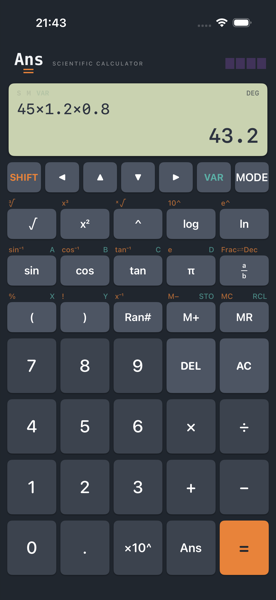
1.2 × 0.8 = 0.96, so whatever the price was, this pair of changes leaves 96% of it: a 4% fall. The intuition that "the second 20% is bigger, because it came off a higher price" is exactly right — £9 on, £10.80 off. What intuition misses is that the order does not matter: take the discount first and £45 becomes £36, then adding 20% reaches the same £43.20, with the rise now the change applied to the smaller number.
To actually undo a 20% rise you divide by 1.2, which is a 16.67% reduction, not a 20% one. Percentages do not have opposites; multipliers have reciprocals.
Where the order really does matter. Two percentages commute because multiplication does. Mix a percentage with a fixed amount and it stops being true: a £5 voucher then 20% off is (45 − 5) × 0.8 = £32, while 20% off then the voucher is 45 × 0.8 − 5 = £31. The gap is 20% of the £5 — the voucher either gets discounted along with everything else or it does not. Shops choose which way round, and it is worth reading the small print.
Reverse percentages: the price before the discount
A coat costs £54 in a sale marked 20% off. What was it before? The tempting move is to add 20% back — 54 × 1.2 = £64.80 — and it is wrong, because the 20% was taken off the original, not off the sale price.
Multipliers make it obvious. Something was multiplied by 0.8 to give 54, so undo the multiplication:
Check it forwards: 67.50 × 0.8 = 54 exactly. The wrong answer fails the same check — 64.80 × 0.8 = £51.84, not £54 — and that check costs one keypress, which is why it is worth doing every time.
The same trap, wearing a suit. VAT works identically: a £120 bill including 20% VAT contains £20 of VAT, not £24, because the £120 is 120% of the net. Divide by 1.2 to get £100. Anyone who multiplies by 0.8 instead arrives at £96 and is out by four pounds on every invoice.
Five years of −10% is not −50%
A £2,000 asset losing 10% of its value each year. Ten per cent five times sounds like half of it gone. It is not, because each year's 10% is taken from a smaller amount than the year before — the multiplier is applied again, not the subtraction:
f₁(x) = 2000×0.9^x f₂(x) = 2000-200x
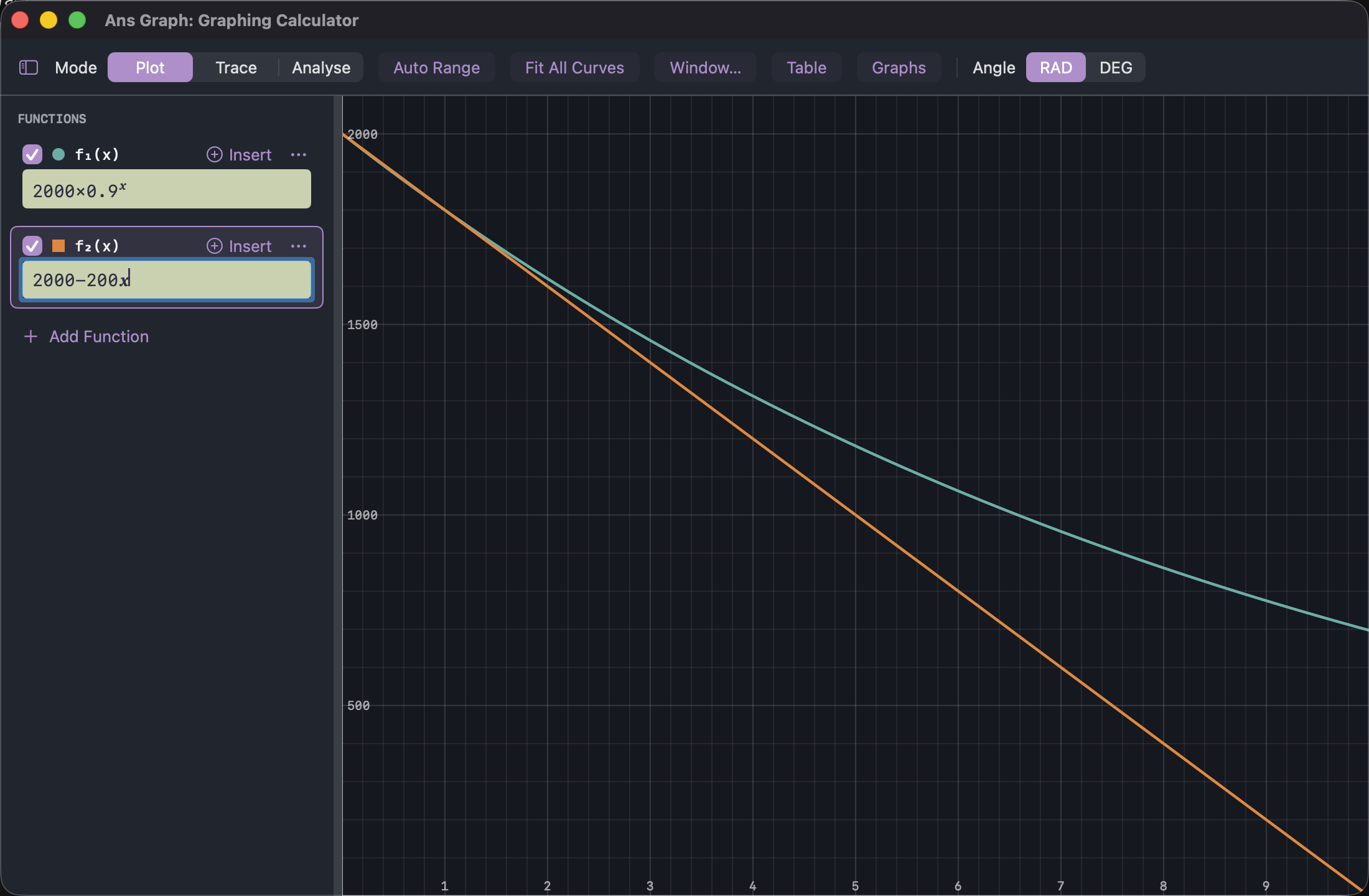
After five years: 2000 × 0.95 = £1,180.98, where the straight line predicts £1,000. The total fall is 40.95%, not 50% — and the gap only widens, because the curve is approaching zero without ever arriving while the line simply runs out at ten years.
This is the compound interest curve upside down. Growth and decay are the same arithmetic with the multiplier on either side of 1, which is why an interest rate and a depreciation rate behave so differently from the way they are usually described in words.
Every sum on this page
| Question | Sum | Answer |
|---|---|---|
| £45 up 20% | 45 × 1.2 | £54.00 |
| £45 down 20% | 45 × 0.8 | £36.00 |
| Up 20%, then down 20% | 45 × 1.2 × 0.8 | £43.20 |
| Down 20%, then up 20% | 45 × 0.8 × 1.2 | £43.20 |
| 20% of £45, using the % key | 45 × 20% | £9.00 |
| £54 after 20% off — the original | 54 ÷ 0.8 | £67.50 |
| VAT inside a £120 bill | 120 − (120 ÷ 1.2) | £20.00 |
| £5 voucher, then 20% off | (45 − 5) × 0.8 | £32.00 |
| 20% off, then the £5 voucher | 45 × 0.8 − 5 | £31.00 |
| £2,000 losing 10% a year for 5 years | 2000 × 0.95 | £1,180.98 |
What to watch
- Percentage changes multiply, they do not add. Two 10% rises are 21%, not 20%, and the difference grows with the number of steps.
- A percentage is always of something. Most errors in this topic are about which quantity it was a percentage of, not about the arithmetic.
- Percentage points and per cent are different units. Moving from 4% to 5% is one percentage point and a 25% increase, and both statements are true at once.
- The % key divides by 100 and nothing else. It does not know whether you meant to add the result on.
- Money is rounded to the penny at each real-world step, which is not the same as rounding once at the end. For a single sale it does not matter; across a year of invoices it does.
Next: compound interest, which is this page's multiplier applied twenty times in your favour.
- Free
- No ads
- No tracking
- No account
- Every sum shown in full

Worked on Ans — a scientific calculator you can own and Ans Graph. A % key that means exactly one thing, every time.