Worked example · Mathematics
Quadratic equations: by factorising, by formula, and by looking
Some quadratics factorise in your head. Most do not, and the formula exists for those. Then there is the third kind — equations with no formula at all, where the only honest methods are numerical. This page walks all three, and the last one is solved twice: once by a graph and once by pressing a single key over and over.
The case that factorises
Solve x² − 5x + 6 = 0. Look for two numbers that multiply to 6 and add to −5: that is −2 and −3, so the expression is (x − 2)(x − 3), and a product is zero only when one of its factors is. The roots are x = 2 and x = 3.
No calculator earns its keep here, and none is offered. What matters is the idea it establishes: solving means finding where an expression is zero, and that is the same question the next two rungs ask in harder circumstances.
The quadratic formula, with a, b and c stored
Now 2x² + 3x − 7 = 0. Nothing obvious multiplies and adds, because the roots are not whole numbers. The formula handles every quadratic there is:
- a, b, c the coefficients of ax² + bx + c = 0 · the part under the root, b² − 4ac, is the discriminant
This is the calculation variables were made for: three numbers used four times between them, and a formula you will want to run again on the next question. Store them first — STO is the VAR function of M+, and the letters sit on the VAR layer of sin, cos and tan:
- 2
- VAR
- STO
- A
- 3
- VAR
- STO
- B
- −7
- VAR
- STO
- C
The calculator now holds
- A
- 2
- the x² coefficient
- B
- 3
- the x coefficient
- C
- −7
- the constant term
That panel is the equation itself, held in the machine. Every expression below reads like the formula in a textbook because the letters on the screen are the letters in the formula.
Check the discriminant before anything else. It decides how many roots there are, so it is worth its own line rather than being buried inside the formula:
- VAR
- B
- x²
- −
- 4
- VAR
- A
- VAR
- C
- =
Positive means two roots, zero means one repeated root, negative means none on the real line — and 65 is not a perfect square, which is precisely why nothing factorised. Now the formula itself, with the plus branch:
- (
- −
- VAR
- B
- +
- √
- VAR
- B
- x²
- −
- 4
- VAR
- A
- VAR
- C
- )
- )
- ÷
- (
- 2
- VAR
- A
- )
- =
For the other one, press ▲ to bring the expression back, change the + to a −, and evaluate again: −2.765564437. That is the whole argument for typing it as one expression with the coefficients in variables — the second root costs one edit, and the next question costs three new stores.
Check them without re-solving. The two roots must add to −b/a and multiply to c/a. Here that is −1.5 and −3.5, and 1.265564437 + (−2.765564437) = −1.5 exactly. A check that uses different arithmetic from the answer is worth more than reading the same sum twice.
The same roots, as a picture
A root is where the curve crosses the x-axis, so plotting the left-hand side turns "solve it" into "look at it":
f₁(x) = 2x^2+3x-7
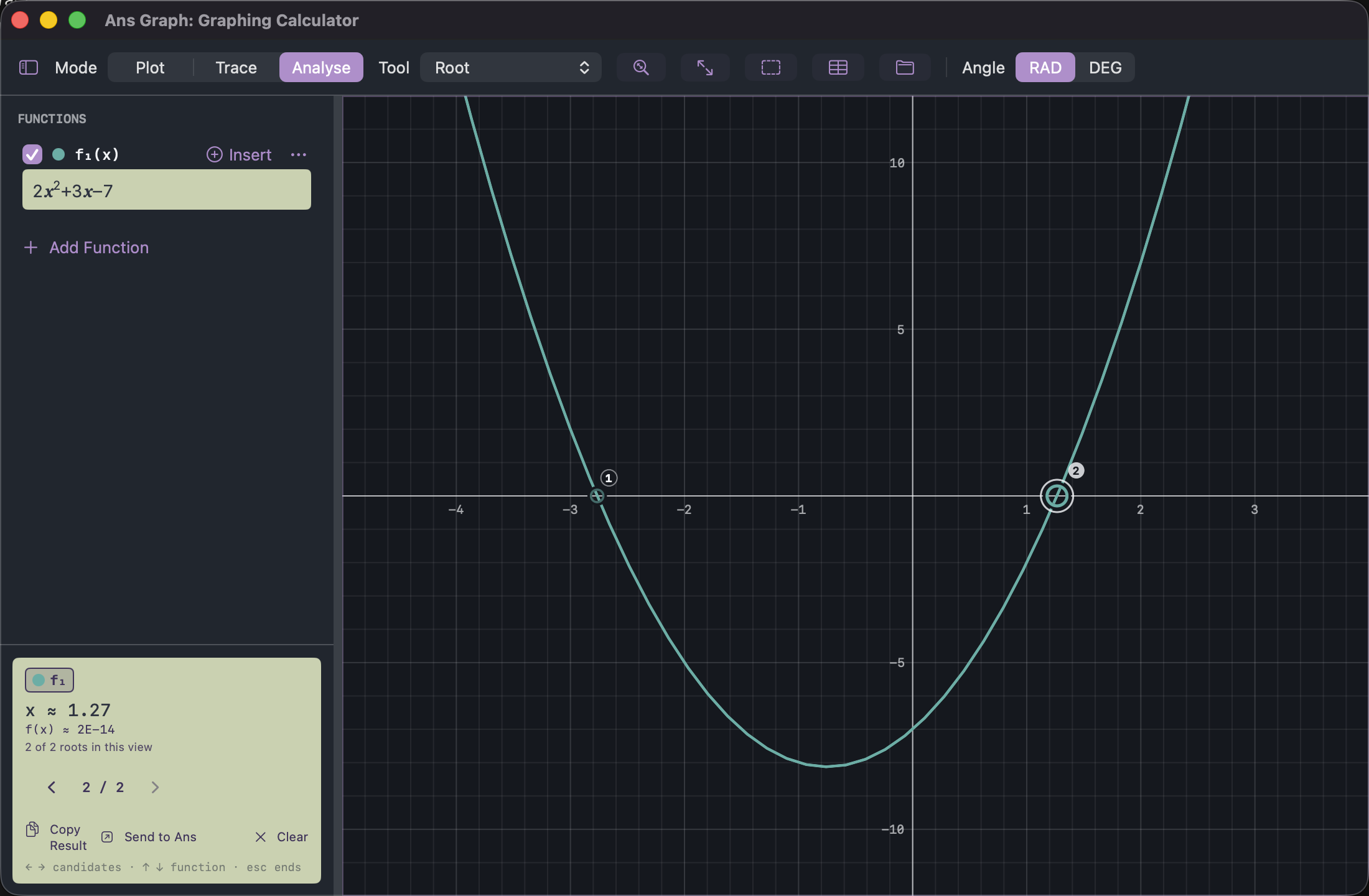
The register says how many roots are in the current view, which is a guard the formula cannot offer: a curve dragged half out of the window has roots you cannot see, and the app tells you so rather than quietly reporting one of them.
The discriminant is visible here too. Slide the constant term up and the whole parabola rises: the two crossings move together, meet when b² − 4ac = 0, and then leave the axis entirely. That is what "no real roots" looks like — a perfectly good curve that simply never gets there.
Solving cos x = x
There is a quadratic formula, a cubic formula and a quartic formula. There is no formula for cos x = x — not because nobody has found one, but because no expression built from the usual operations can produce that root. It has a perfectly definite value all the same, and two ordinary instruments will find it.
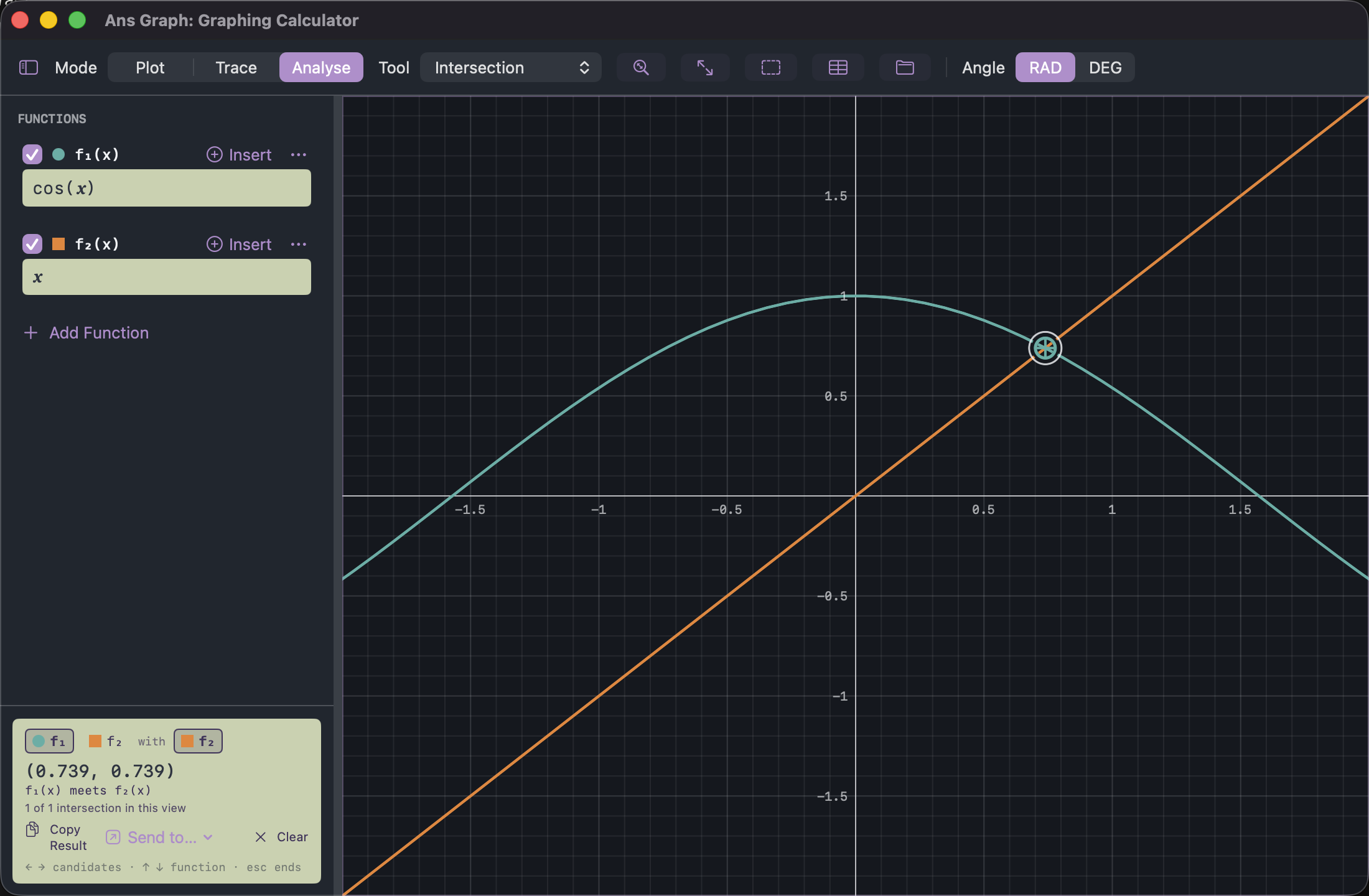
On the graph, plot both sides and ask where they meet. Make sure the angle unit is RAD; in degrees this is a different equation with a different answer:
f₁(x) = cos(x) f₂(x) = x
The same number, by pressing one key
On the calculator, put it in RAD, type any starting value, and take the cosine of the answer over and over. Each result becomes the next input, and the values walk in towards the crossing:
- 1
- =
- cos
- Ans
- )
- =
- ▲
- =
| Presses | Display |
|---|---|
| 1 | 0.5403023059 |
| 2 | 0.8575532158 |
| 5 | 0.7013687736 |
| 10 | 0.7442373549 |
| 20 | 0.7391843998 |
| 50 | 0.7390851339 |
| 100 | 0.7390851332 |
It settles because cosine is a contraction near that point: every pass shrinks the distance to the answer by about a third. Start from 0, from 100, from anything — the same number comes back. It has a name, the Dottie number, and no closed form; this is what "solving" means when there is no formula to reach for.
Degrees would give a different answer. In DEG the equation is cos(x°) = x, which crosses near 0.9998 — a different question with a different root. The angle unit is part of the equation, not a display preference, which is why both apps show it on screen at all times.
The three equations, side by side
| Equation | Roots | Method |
|---|---|---|
| x² − 5x + 6 = 0 | 2 and 3 | Factorising |
| 2x² + 3x − 7 = 0 | 1.265564437, −2.765564437 | Formula, and Root on the graph |
| cos x = x (radians) | 0.7390851332 | Intersection, and iteration |
What to watch
- The formula is exact arithmetic; the graph's roots are numerical and come with a stated resolution. Where both are available, the formula is the one to quote.
- A large b with a small ac can lose precision in b² − 4ac on any calculator. If the two roots come out suspiciously close in size, solve the well-conditioned root first and get the other from the product c/a.
- Root and Intersection report only what is in the current view. Fit the curve before believing a count.
- Iteration converges here because cosine is a contraction near the fixed point. The same trick diverges for other equations — it is a method with conditions, not a universal one.
- The angle unit changes what cos x = x means. RAD throughout this page.
Next: projectile motion, where a root is a landing point and an extremum is the top of a throw.
- Free
- No ads
- No tracking
- No account
- Every sum shown in full
Worked on Ans — a scientific calculator you can own and Ans Graph. Six variables, a replay key, and roots you can see.