Worked example · Physics
Carbon dating: reading an age out of what's left
A piece of charcoal from a hearth holds 22% of the carbon-14 that a living thing would. How old is it? Halving is easy while the answer is a whole number of half-lives; 22% is not. This page does the easy case on paper, turns it into a logarithm that handles any fraction, dates the real sample, and then shows where the method stops being a measurement.
Half-life, while the answer is a whole number of halvings
A half-life is the time for half of whatever is left to decay — and the "whatever is left" is the important part. It is not half of the original each time; it is half of the current amount, so the sample never quite reaches zero.
Start with 1,000 counts a minute from a source whose half-life is 5 days. After 5 days: 500. After 10: 250. After 15: 125. Three halvings, so:
- N₀ the amount at the start · N the amount left · t elapsed time · T½ the half-life, in the same units as t
- 1000
- ×
- 0.5
- ^
- 3
- =
Turning the halving round with a logarithm
Now the question people actually ask: when will only 10% be left? That is not a whole number of half-lives, and no amount of halving on paper will land on it. The unknown is stuck in the exponent, and a logarithm is the tool that brings it down:
The base does not matter as long as both logarithms use the same one, so the ln key does the whole job. With T½ = 5 days and N/N₀ = 0.1:
- 5
- ×
- (
- ln
- 0.1
- )
- ÷
- ln
- 0.5
- )
- )
- =
Both logs are negative, and that is why the answer is positive. ln(0.1) = −2.302585093 and ln(0.5) = −0.6931471806; a negative divided by a negative gives the positive 3.321928095 half-lives. If a decay answer ever comes out negative, a sign has been dropped rather than time having run backwards.
How to calculate the age of a sample from carbon-14
Living things exchange carbon with their surroundings, so they hold the same proportion of radioactive carbon-14 as the atmosphere. That exchange stops at death, and from then on the carbon-14 only decays, with a half-life of 5,730 years. Measure what fraction is left and the same formula gives the time since it stopped.
Our charcoal is at 22% of modern carbon:
Quoting that as 12,516.75 years would be silly: the measurement of "22%" is not good to seven figures. 12,500 years is the honest statement, and a real laboratory would give it as a figure plus an uncertainty.
The same answer, found by looking
Plot what is left against time and put a line at the measured 22%. Where they meet is the age — no rearranging, and a picture of how sharply the answer depends on the measurement:
f₁(x) = 100×0.5^(x/5730) f₂(x) = 22
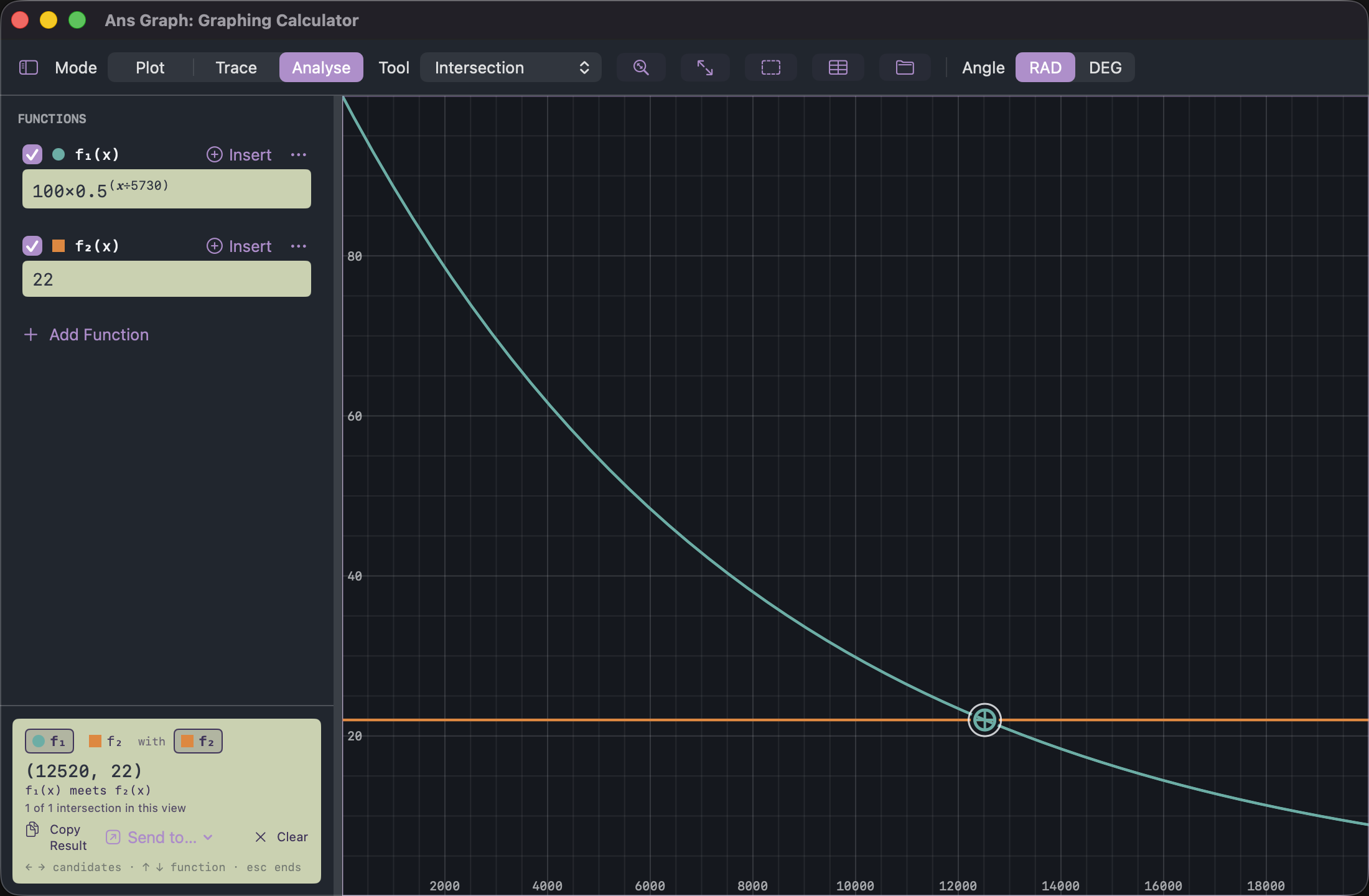
Drag the line up and down and watch how far the crossing moves. The steeper the curve is where it crosses, the less a measurement error costs — and the curve flattens as it falls, so the same one-percentage- point uncertainty is worth more and more:
| Carbon-14 left | Age | ±1 pp is worth |
|---|---|---|
| 50% | 5,730 yr | ± 165 yr |
| 22% | 12,517 yr | ± 376 yr |
| 10% | 19,035 yr | ± 829 yr |
| 5% | 24,765 yr | ± 1,676 yr |
Ten times the precision is needed at the old end to get the same answer, and that sensitivity is the reason radiocarbon has a working limit — which is the next step.
What stops the answer being a date
The constant you use changes the answer
Libby's original half-life for carbon-14 was 5,568 years; the better modern value is 5,730. Published radiocarbon ages are still quoted on Libby's figure by convention, so the same sample gives two different numbers depending on which constant is in the sum:
| Half-life used | Age |
|---|---|
| 5,730 years (modern) | 12,516.8 years |
| 5,568 years (Libby, conventional) | 12,162.9 years |
| Difference | 353.9 years |
Three and a half centuries, from a constant rather than from the sample. Neither number is wrong; a number quoted without saying which convention it used is.
The curve runs out
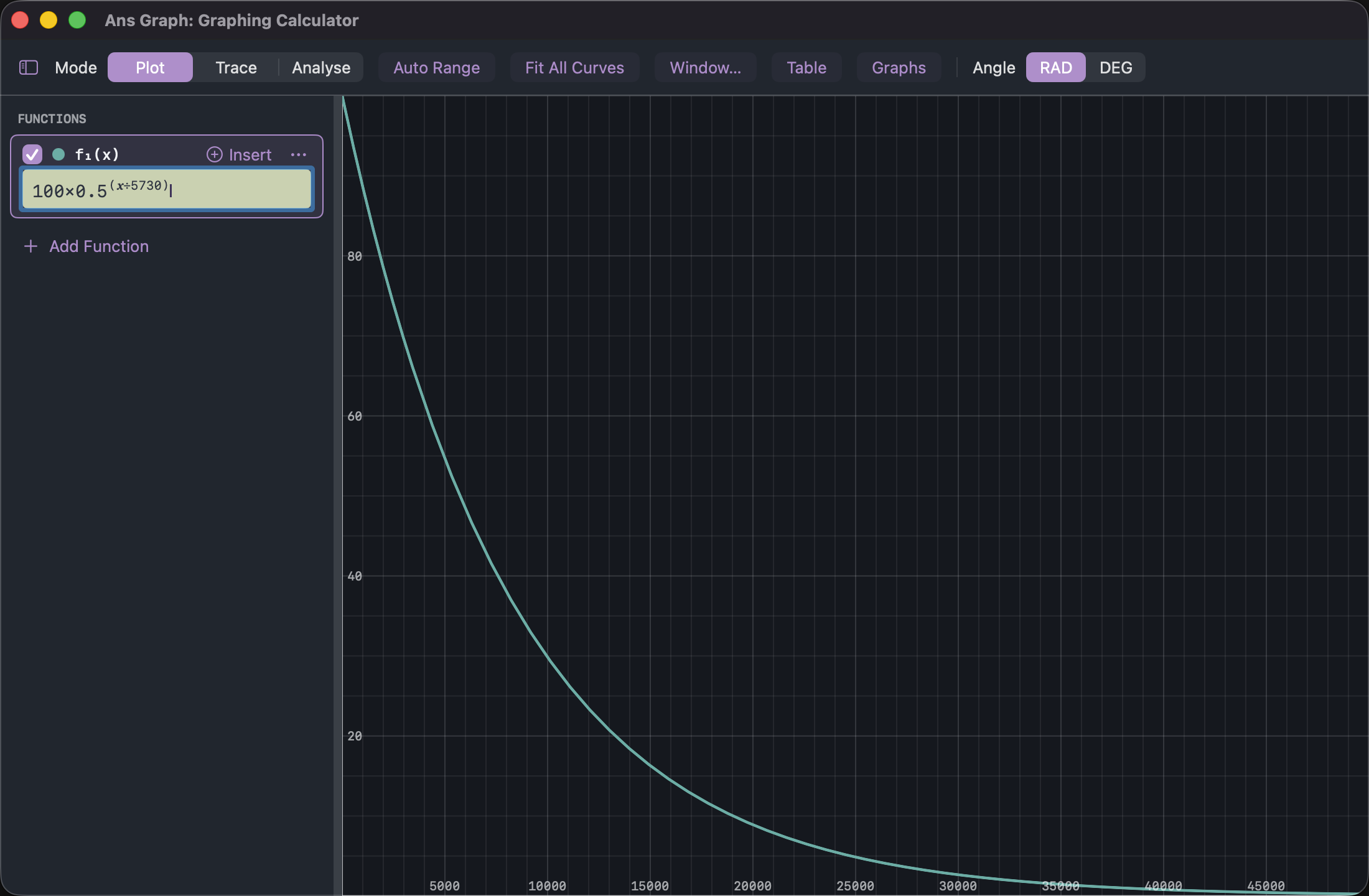
At 50,000 years a sample has been through 8.73 half-lives and holds 0.236% of its original carbon-14 — so little that it is hard to tell from contamination by a trace of modern carbon. Plot the curve out that far and the problem is obvious long before the arithmetic says so: it flattens against the axis, and reading a date off a flat line is reading noise.
And radiocarbon years are not calendar years. The method assumes the atmosphere always held the same proportion of carbon-14, and it did not — it varies with the sun's activity and the Earth's magnetic field, and fossil-fuel burning and 1950s bomb testing moved it sharply. Real dates are therefore calibrated against tree rings and other dated records. The arithmetic on this page is the raw radiocarbon age, which is the input to that calibration rather than the finished date.
Carbon-14 against time
| Age / years | Half-lives | Carbon-14 left |
|---|---|---|
| 0 | 0 | 100% |
| 5,730 | 1 | 50% |
| 11,460 | 2 | 25% |
| 12,517 | 2.18 | 22% |
| 17,190 | 3 | 12.5% |
| 50,000 | 8.73 | 0.236% |
What this model ignores
- The atmosphere is treated as having held a constant proportion of carbon-14. It has not, which is why real dates are calibrated rather than quoted straight from this sum.
- The sample is assumed uncontaminated. A little modern carbon in an old sample makes it look far younger; old carbon in a young one does the reverse.
- Only carbon-14 is considered — a single nuclide with a fixed half-life, no daughter activity and no new production in the sample.
- The measured fraction is treated as exact. It never is, and the whole art of the method is in the uncertainty this page does not carry.
- Below about 0.2% remaining the method stops discriminating, which in practice puts the ceiling near 50,000 years.
Next: solving exponential equations with logarithms for the general method, or calculating pH for another measurement scale built from a logarithm.
- Free
- No ads
- No tracking
- No account
- Every sum shown in full
Worked on Ans — a scientific calculator you can own and Ans Graph. Paid for once, and both work with aeroplane mode on.