Worked example · Chemistry
How to calculate pH from hydrogen-ion concentration — and reverse it
A solution has a hydrogen-ion concentration of 3.2 × 10⁻⁵ mol dm−3. What is its pH? We will begin with powers of ten, type the logarithm exactly as it stands, then run the calculation backwards from pH 5.70. A graph will show why those two questions are the same intersection seen from opposite directions.
pH is a count of powers of ten
Start with concentrations that are exact powers of ten. If [H+] is 1 × 10⁻² mol dm−3, its pH is 2. At 1 × 10⁻³ it is 3, and at 1 × 10⁻⁴ it is 4. The exponent is negative because these concentrations are smaller than one; the minus sign in the pH definition turns that exponent into a positive number:
- [H+] is the numerical hydrogen-ion concentration in mol dm−3 · log10 asks for the power to which 10 must be raised
Our concentration is not a single power of ten. Split it into its two factors and the logarithm becomes ordinary arithmetic:
log10(3.2) is about 0.50515, so the logarithm of the whole concentration is 0.50515 − 5 = −4.49485. Negating it gives a pH just below 4.5. That direction is worth checking before touching a calculator: 3.2 × 10⁻⁵ lies between 10−4 and 10−5, so its pH must lie between 4 and 5.
More hydrogen ions means a lower pH. The scale runs backwards because of the minus sign. Multiplying [H+] by ten lowers pH by exactly one in this model; dividing it by ten raises pH by one.
Enter the concentration in standard form
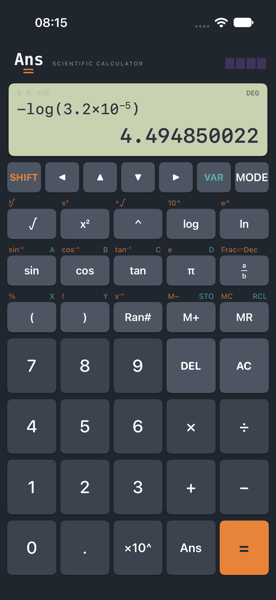
Press AC first. This is the one sum on the page that starts with an operator, and a minus pressed while an answer is still showing means subtract from Ans: the same keys on an uncleared line give Ans−log(3.2×10⁻⁵). Then keep the leading minus outside the logarithm and use the ×10^ key for the concentration. The log key opens its own bracket, so close that bracket after the exponent:
- AC
- −
- log
- 3.2
- ×10^
- −
- 5
- )
- =
How many digits should the answer keep?
The concentration 3.2 × 10⁻⁵ has two significant figures. For a logarithm, those become two digits after the decimal point in the pH, so the honest result is pH 4.49. If the measured concentration had been given to three significant figures, 3.20 × 10⁻⁵, the corresponding report would be pH 4.495. The calculator's 4.494850022 is useful for carrying into another calculation, not a claim that the sample was measured to ten significant figures.
How to find hydrogen-ion concentration from pH
Suppose instead that a meter reports pH 5.70. The inverse of a base-ten logarithm is a power of ten, so rearranging the definition gives:
10^ is the SHIFT function of the log key. Pressing SHIFT then log inserts the power and its opening bracket as one construct:
- SHIFT
- log
- −
- 5.70
- )
- =
Two decimal places in the pH correspond to two significant figures in the concentration, so the reported answer is 2.0 × 10⁻⁶ mol dm−3. Writing 1.995262315 × 10⁻⁶ as the final measurement would again turn calculator digits into precision the experiment never supplied.
The reverse calculation as an intersection
Plot pH against positive hydrogen-ion concentration, then add a horizontal line at the measured pH. In Ans Graph enter these two expressions:
f₁(x) = -log(x) f₂(x) = 5.70
Use a window around x = 1E−7 to 5E−6 and y = 5 to 7, then choose Intersection. The crossing gives the concentration on the x-axis and the pH on the y-axis: x ≈ 1.995 × 10⁻⁶, y = 5.70.
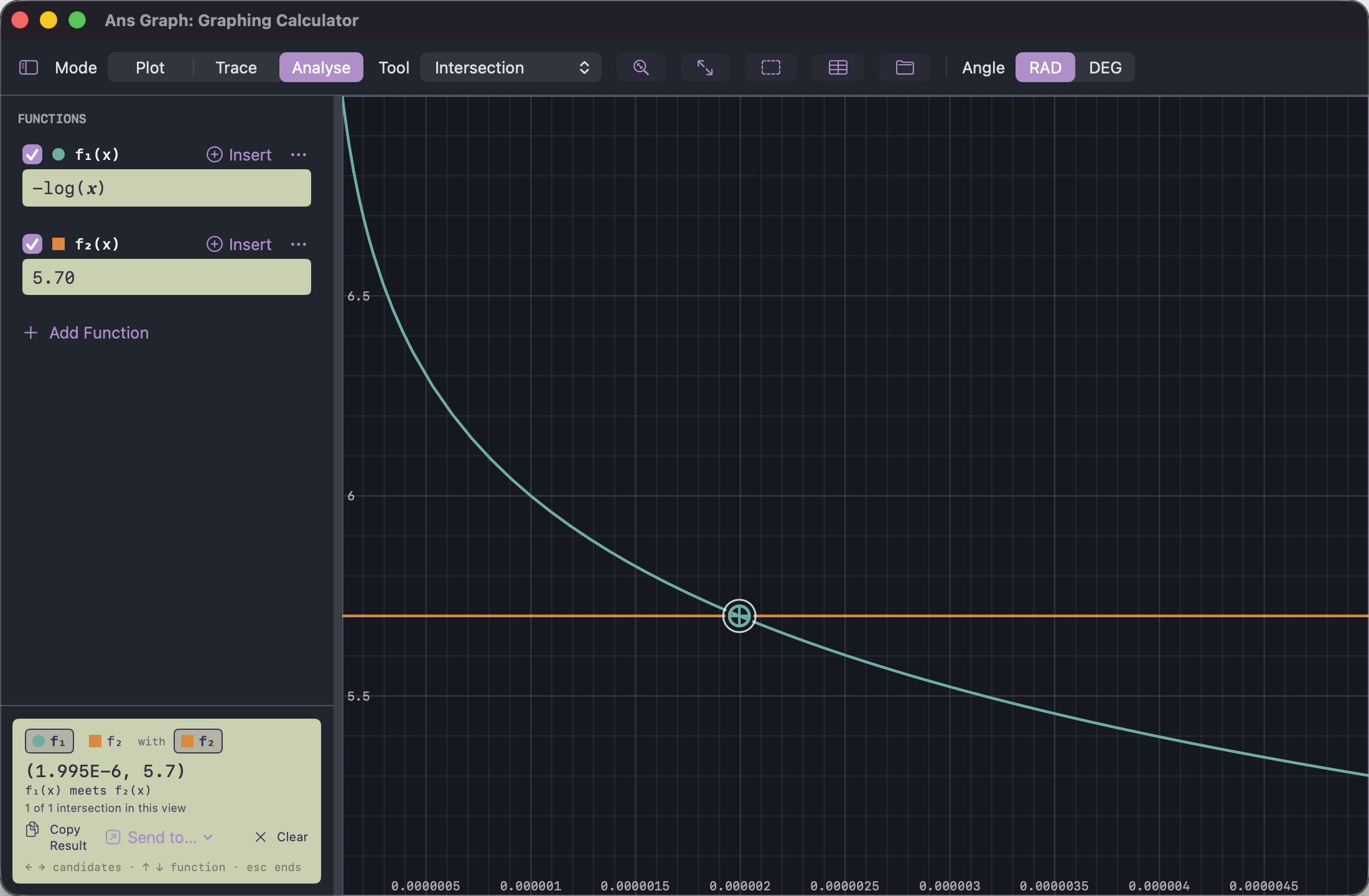
The curve falls steeply because equal steps in pH are ratios, not equal subtractions in concentration. Moving from pH 5 to pH 6 does not remove 1 mol dm−3, or any other fixed amount: it divides [H+] by ten. That is the feature a straight-line sketch hides and the logarithmic curve makes visible.
x = 0 is outside the formula. log(0) is undefined, and a negative concentration has no physical meaning. Start the graph window at a small positive value rather than asking the curve to include zero.
What a tenfold dilution does to pH
Take 25.0 cm³ of the original solution and dilute it to 250.0 cm³. The final volume is ten times larger, so the idealised hydrogen-ion concentration is ten times smaller:
AC first again — Step 3's answer is still on the display, and the leading minus would subtract from it. That mistake is hard to spot here, because it gives 5.494852017: right to six figures and wrong after them.
A tenfold dilution raises the pH by one because it subtracts one from the concentration's exponent. More generally, diluting by a factor D raises the idealised pH by log10(D): a twofold dilution changes it by only about 0.301, not by half a pH unit.
This shortcut has a boundary. Keep diluting an acid and eventually the water's own hydrogen ions are no longer negligible. The simple “divide concentration, add to pH” model cannot be extended through that region as though the solvent contributed nothing.
Concentration and pH in both directions
| Given | Calculation | Report |
|---|---|---|
| [H+] = 1.0 × 10⁻² mol dm−3 | −log(1.0 × 10⁻²) = 2 | pH 2.00 |
| [H+] = 1.0 × 10⁻⁴ mol dm−3 | −log(1.0 × 10⁻⁴) = 4 | pH 4.00 |
| [H+] = 3.2 × 10⁻⁵ mol dm−3 | −log(3.2 × 10⁻⁵) = 4.494850022 | pH 4.49 |
| [H+] = 3.2 × 10⁻⁶ mol dm−3 | −log(3.2 × 10⁻⁶) = 5.494850022 | pH 5.49 |
| pH 5.70 | 10−5.70 = 1.995262315 × 10⁻⁶ | 2.0 × 10⁻⁶ mol dm−3 |
What this pH model leaves out
- The school formula treats concentration as hydrogen-ion activity. Strictly, pH is −log10 of a dimensionless activity; concentration is a good approximation only where interactions between ions are small.
- A stated acid concentration is not automatically [H+]. Strong acids may be treated as fully dissociated in simple dilute problems; weak acids require an equilibrium calculation using their acid dissociation constant.
- Water also supplies H+ and OH−. Its contribution can be ignored for the concentrations on this page, but not after repeated dilution towards neutrality.
- Neutral does not mean exactly pH 7 at every temperature. The ionic product of water changes with temperature, so the neutral pH changes with it.
- A real pH measurement depends on calibration, electrode condition, temperature compensation and sample composition. Extra digits on a display do not remove those uncertainties.
- The familiar 0–14 scale is a useful range for dilute aqueous solutions, not an absolute boundary. Concentrated and non-ideal solutions can lie outside it.
Next: carbon dating, where a logarithm turns another exponential relationship backwards, or exact values and rounding, where the digits a calculator holds are separated from the precision a result has earned.
- Free
- No ads
- No tracking
- No account
- Every sum shown in full
Worked on Ans — a scientific calculator you can own, where log and 10^ share one key, and Ans Graph, where the inverse calculation becomes an intersection. Paid for once, with no subscription.