
Worked example · Mathematics
Solving exponential equations with logarithms: 3x = 20
Powers are easy to undo when the answer is exact: 32 = 9 and 33 = 27. But what power of 3 gives 20? It lies somewhere between 2 and 3, and no amount of tidy factorising will name it. A logarithm brings the unknown exponent down where ordinary division can reach it.
When both sides can be written with the same base
Start with 3x = 81. Since 81 = 34, equal powers with the same positive base have equal exponents, so x = 4. The same idea solves 2x = 1/8 because 1/8 = 2−3, giving x = −3.
Twenty is not an integer power of 3. We can still bracket the answer: 9 < 20 < 27, so 2 < x < 3. That estimate is the check the decimal answer must pass.
Take a logarithm of both sides
Logarithms turn powers into multiplication. Taking the natural logarithm of both sides does not change the equality, then the power rule moves x in front of the logarithm:
- ln
- 20
- )
- ÷
- ln
- 3
- )
- =
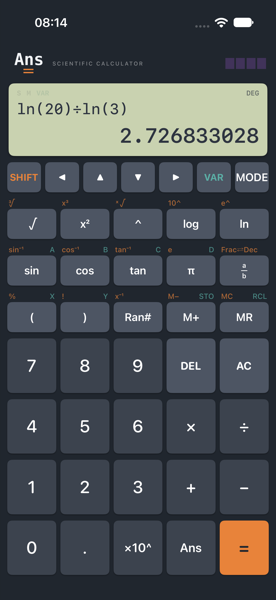
Common log works too. log(20)÷log(3) gives the same result. The base cancels through the change-of-base formula; mixing bases between the top and bottom is the mistake. Use ln for both or log for both.
The answer is where 3x meets 20
Plot the two sides of the equation as separate functions. Their crossing is the x-value that makes them equal. Set the window to x from 0 to 4 and y from 0 to 30, then choose Intersection:
f₁(x) = 3^x f₂(x) = 20
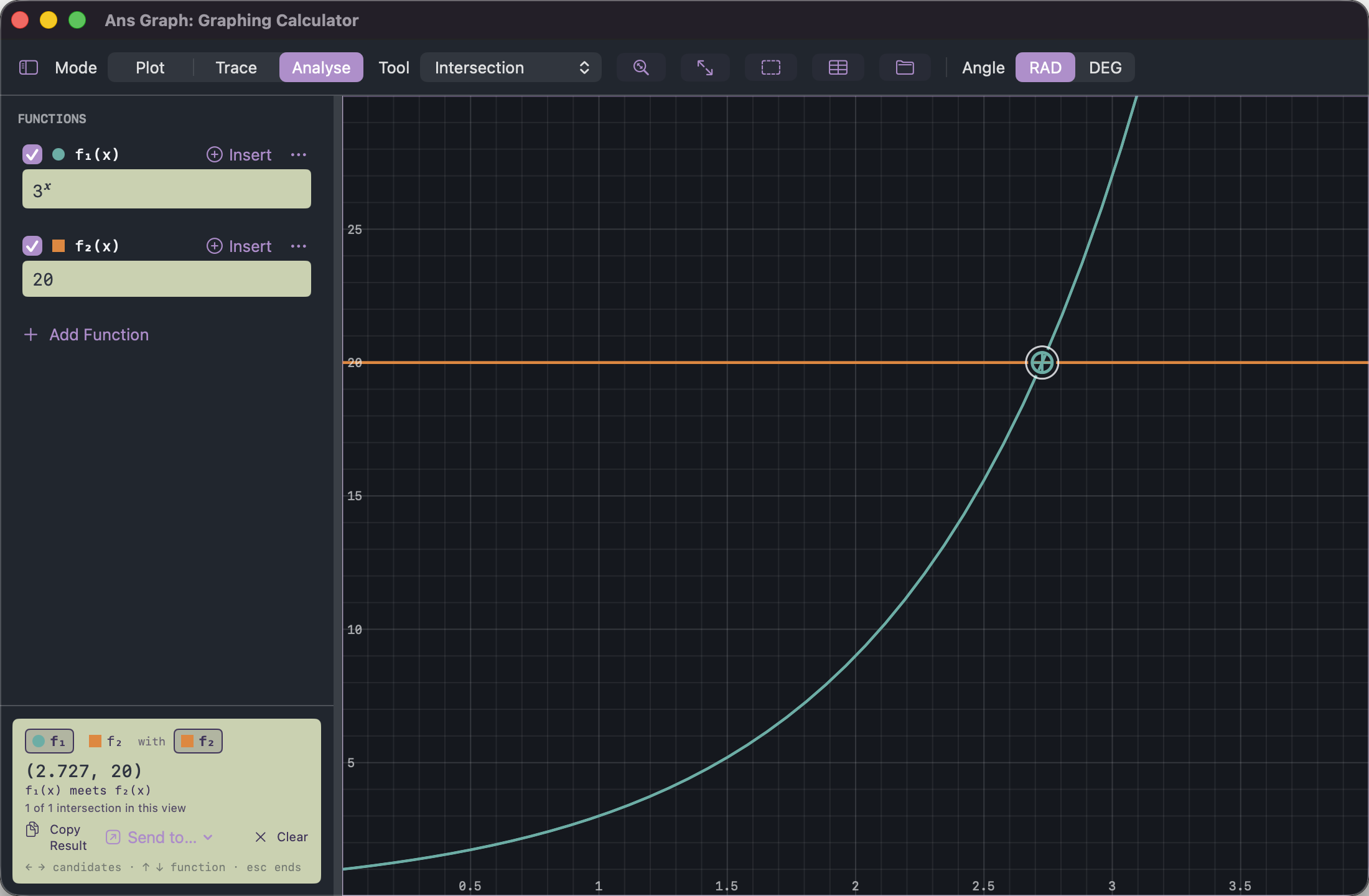
The curve also explains why there is only one real answer. For base 3, 3x is positive and strictly increasing: every positive target height is crossed once. A target at zero or below would never be met.
When does a growing culture quadruple?
A model starts with 500 cells and grows by 18% each hour. Under the model, after t hours there are 500×1.18t cells. To find when the count reaches 2,000:
The model reaches 2,000 after about 8 hours 23 minutes. The hourly checkpoints bracket it: after 8 hours the model gives 1,879 cells, and after 9 hours 2,218. If growth is only applied in whole hourly steps, the first recorded count at or above 2,000 is therefore the 9-hour reading; the fractional answer assumes growth acts continuously between those readings.
| Question | Logarithm result | Substitution check |
|---|---|---|
| 3x = 20 | x = 2.726833028 | 32.726833028 ≈ 20 |
| 500×1.18t = 2000 | t = 8.375670267 h | 500×1.188.375670267 ≈ 2000 |
| One hour earlier | t = 8 | 1,879.43 cells |
| One hour later | t = 9 | 2,217.73 cells |
What the growth model assumes
- The 18% fractional growth rate stays constant, with no shortage of nutrients, space or oxygen.
- The population is treated as a continuous quantity even though cells are discrete.
- The same exponential law is extended between hourly observations; a process updated only at whole hours gives a different operational answer.
- The starting count and rate are treated as exact. Real biological measurements would limit the useful precision of the time.
Next: compound interest for the same mathematics attached to money, carbon dating for a decreasing exponential turned backwards with logarithms, or calculating pH for a logarithm used as a measurement scale.
- Free
- No ads
- No tracking
- No account
- Every sum shown in full


Worked on Ans — a scientific calculator you can own and Ans Graph. The logarithm gives the digits; the intersection shows why they are the answer. Both are paid for once.