Worked example · Mathematics
Exact answers, and where they run out
Most calculators turn everything into a decimal the moment you press equals, and a decimal is a lossy copy of most fractions. This page shows what is kept when a calculator refuses to do that — exact fractions, and a π that is still π when the next function asks — then finds the edge, because the edge is real and a page that only showed the good half would be advertising.
A third plus a sixth is a half, and it says so
Add ⅓ and ⅙ by hand and you put them over a common denominator: 2/6 + 1/6 = 3/6 = ½. Exact, and no decimal involved at any point. Type the same thing in:
- (
- 1
- ÷
- 3
- )
- +
- (
- 1
- ÷
- 6
- )
- =
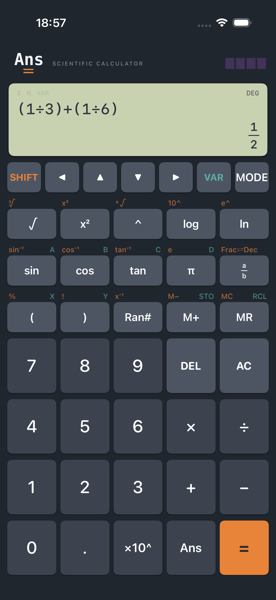
That matters when the answer carries on into the next line. A third stored as 0.3333333333 is already wrong in the eleventh digit, and three of them add up to 0.9999999999 rather than 1. Kept as ⅓, three of them are exactly 1 — which is the answer a person would give.
One decimal point changes the whole line. Ans shows a fraction unless your input contained a decimal point or a ×10^ exponent — so (1÷3)+(1÷6) gives 1/2, while (1÷3)+0.5 gives 0.8333333333. The rule is that the calculator answers in the language you asked in, and the moment you introduce a decimal you have said you want decimals.
Why sin(π) is 0 and sin(3.141592654) is not
π is not 3.141592654. That is a ten-figure approximation, and the difference shows up the moment you do something sensitive with it. The sine of π is exactly zero — that is what π is, the point where the sine curve comes back to the axis. Ask for it in radians both ways:
- sin
- π
- )
- =
The display is not where the exactness lives. Press π and = on its own and you get 3.141592654 — ten figures, like any other number, because that is what a ten-figure display can show. Nothing symbolic appears on screen. What is kept is underneath, in the value the next function receives, and the pair of answers above is the proof: the same π that printed as digits went into sin as π.
Four ten-billionths is not an error worth worrying about on its own. It is worth understanding: the calculator holds rational multiples of π as multiples of π, so anything that lands on a clean value comes out clean — sin(π) and tan(π) are 0, cos(2π) is 1, and sin(π÷6) is exactly 0.5 rather than 0.4999999999. Type the digits instead and you are asking a slightly different question, and getting an honest answer to it.
This is a small mercy with a large cousin. The same idea is why exact fractions matter in a long calculation: every rounding is a tiny lie, and lies accumulate. Keeping the exact form until the last possible moment is the single most effective habit in numerical work, and it costs nothing.
A graph can only measure π, never know it
Ask the graph the same question. Plot the sine curve in radians and find where it crosses the axis:
f₁(x) = sin(x)
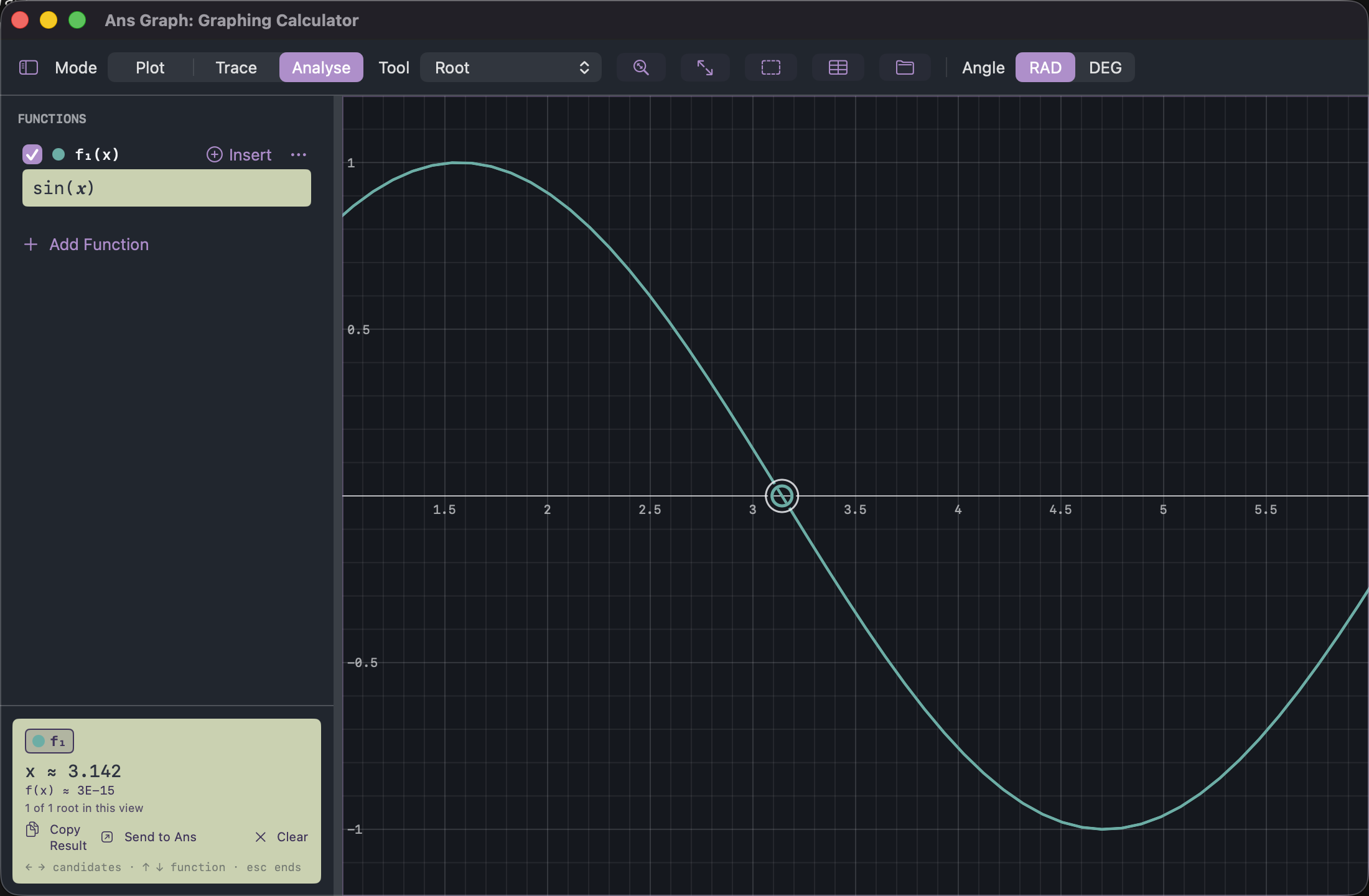
That is the honest difference between the two instruments, and it is not a deficiency in either. The graph searched for the crossing and reports what it found, with an uncertainty attached. The calculator did not search: it recognised π as π and folded the sine symbolically, so its zero has no uncertainty at all.
Numerical methods find answers that no formula can reach — that is what the cos x = x page is about. Exact methods give answers that no measurement can match. A page that pretends either one is simply better than the other has not used both.
Where the exactness stops
Ans keeps two families exactly and no others: fractions with whole-number tops and bottoms, and rational multiples of π. That list is deliberate rather than unfinished — those two cover the answers school and A-level work actually produces, and each has a compact exact form a calculator can carry through a calculation without a computer algebra system behind it. Everything else becomes a decimal at the point it is computed. So there are no surds, and there is a ceiling.
√2 is a decimal here
√2 gives 1.414213562, not a symbol. There is no exact form kept for it, so a chain of surds will drift in the last digits where a symbolic system would stay perfect. If your working needs √2 to survive as √2, it has to survive on your paper.
And there is a ceiling
The engine works up to — but not including — 10100. Factorials cross that line in one step, which makes them the neatest way to see it:
An instrument that stopped quietly, or wrapped round to a small number, or offered infinity, would be worse than one that refuses. Math ERROR is a complete answer to the question "can you hold this?" — and knowing exactly where the boundary sits, at 10100 inclusive, means you can work out in advance whether a calculation will reach it.
What is kept, and what is not
| Expression | Answer | Kept exactly? |
|---|---|---|
| (1÷3)+(1÷6) | 1/2 | yes, as a fraction |
| (1÷2)+(1÷3) | 5/6 | yes |
| (1÷3)+0.5 | 0.8333333333 | no — a decimal was asked for |
| sin(π) | 0 | yes, as a π multiple |
| sin(3.141592654) | −4.102070669×10⁻¹⁰ | no — π was rounded first |
| π | 3.141592654 | yes, underneath — the display has no symbol for it |
| √2 | 1.414213562 | no — no surds are kept |
| 69! | 1.711224524×10⁹⁸ | within range |
| 70! | Math ERROR | past 10¹⁰⁰ |
What to watch
- Exact fractions are held with whole-number tops and bottoms. A calculation that overflows those falls back to decimals silently — correct, but no longer exact.
- Only rational multiples of π are folded symbolically. π² and eπ are decimals like anything else.
- Trigonometric functions of ordinary angles are computed, not derived: sin(60°) is 0.8660254038, not √3/2. The exactness here is about fractions and π, not about surds.
- Decimal answers are shown to ten significant figures from fifteen held internally, so what you see is already one rounding away from what the next line will use. A fraction has no such gap.
- The 10100 ceiling is inclusive: 1×10⁹⁹ × 10 is a Math ERROR, not 10¹⁰⁰.
Next: standard form on a scientific calculator, where powers of ten have to be entered as carefully as exact values, or solving equations numerically.
- Free
- No ads
- No tracking
- No account
- Every sum shown in full
Worked on Ans — a scientific calculator you can own, which keeps fractions as fractions, and Ans Graph, which says how sure it is.