Worked example · Physics
Inverse-square law: intensity from a point source
A small source radiates 1,200 W equally in every direction. What is the intensity 3 m away, and how far away has it fallen to 2 W m−2? The square is not an arbitrary rule: it comes from the area of the sphere over which the same power is spread.
Why doubling distance quarters the intensity
At distance r, radiation from an ideal point source is spread over a sphere of area 4πr2. Intensity is power per unit area:
- I intensity in W m−2 · P total radiated power in W · r distance from the point source in m
Double r and the sphere's area becomes 22 = 4 times larger. The same power is divided among four times the area, so the intensity is one quarter. Triple the distance and intensity becomes one ninth. It is 1/r2, not 1/r.
| Distance | Sphere area factor | Intensity factor |
|---|---|---|
| r | 1 | 1 |
| 2r | 4 | 1/4 |
| 3r | 9 | 1/9 |
| 10r | 100 | 1/100 |
Intensity 3 m from a 1,200 W source
Substitute P = 1200 W and r = 3 m. Keep the entire sphere area in the denominator; the brackets make that visible:
- 1200
- ÷
- (
- 4
- ×
- π
- ×
- 3
- x²
- )
- =
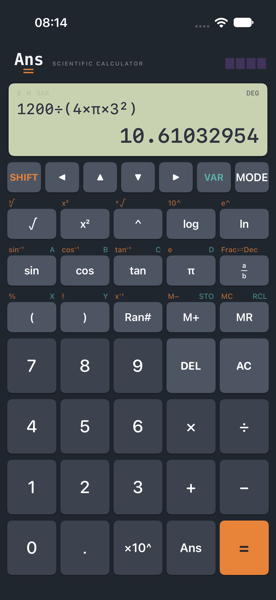
At 1 m the intensity would be 95.493 W m−2. At 3 m, one ninth of that is 10.610 W m−2, providing a quick independent check.
Do not square the power. The square belongs to distance because the receiving sphere grows in two dimensions. The source still emits 1,200 joules each second; only the area over which those joules are spread changes.
Where does the intensity fall to 2 W m−2?
Rearrange before substituting. Multiply by r2, divide by I, then take the positive square root because distance is positive:
The threshold is reached at about 6.91 m. Beyond that, the idealised intensity is below 2 W m−2; closer than that, it is above. Substitution closes the loop: 1200÷(4π×6.9098829892) ≈ 2.
| Distance | Intensity | Compared with 1 m |
|---|---|---|
| 1 m | 95.493 W m−2 | 1 |
| 2 m | 23.873 W m−2 | 1/4 |
| 3 m | 10.610 W m−2 | 1/9 |
| 6 m | 2.653 W m−2 | 1/36 |
| 6.910 m | 2.000 W m−2 | about 1/47.75 |
| 10 m | 0.95493 W m−2 | 1/100 |
Find the threshold as an intersection
Plot the intensity against positive distance and add the 2 W m−2 threshold. The function rises without bound as x approaches zero, so start the window at 1 m rather than asking the graph to include the point-source singularity. Then keep the ceiling low: y from 0 to 12 still shows the 10.6 W m−2 reading at 3 m, and leaves the 2 W m−2 crossing clear of the axis. A window tall enough for the 95 W m−2 at 1 m would squash that crossing into the bottom edge. Use x from 1 to 10, then choose Intersection.
f₁(x) = 1200/(4*pi*x^2) f₂(x) = 2
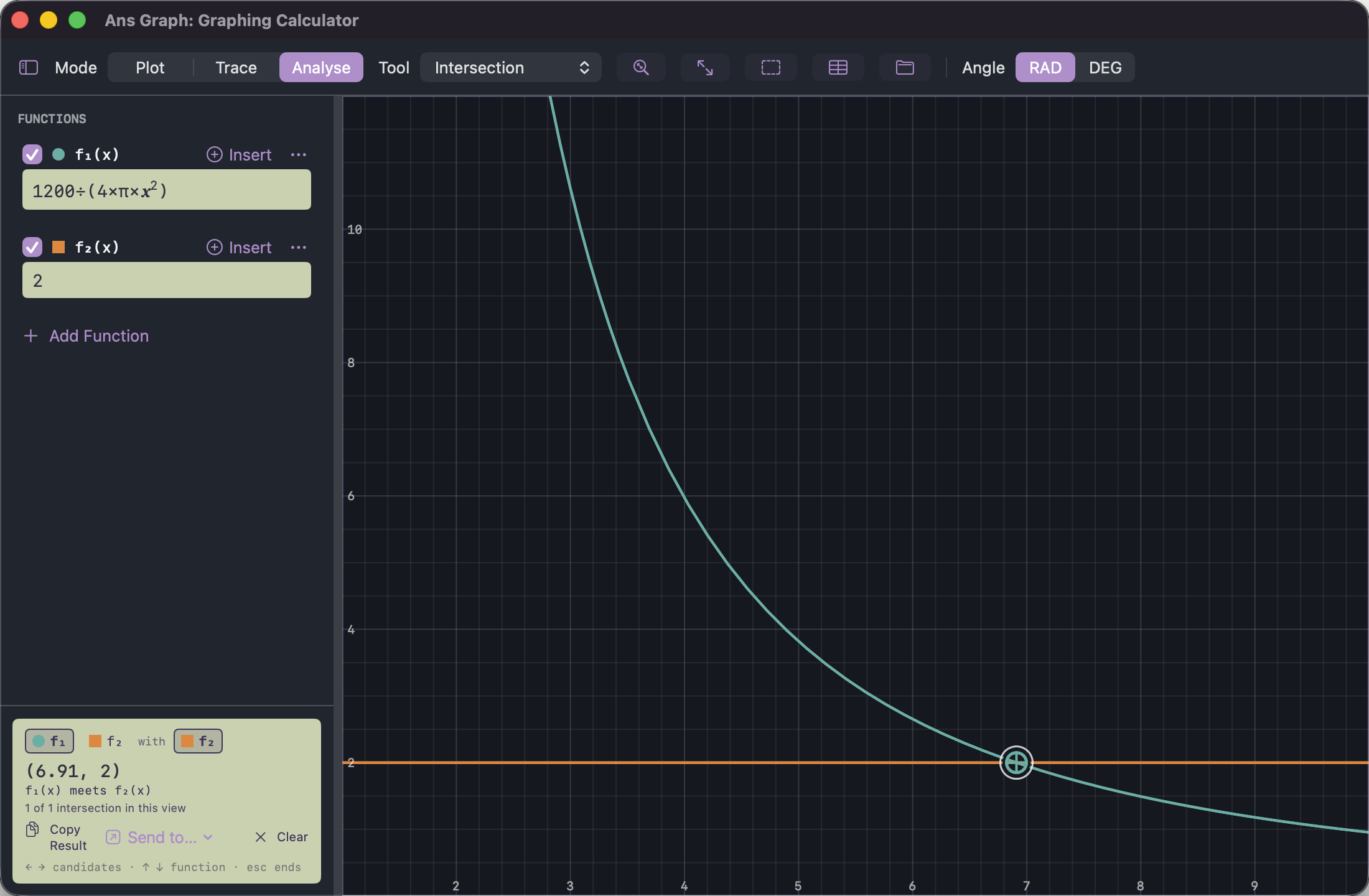
The plot makes the sensitivity visible. Close to the source, a small move changes intensity sharply; farther away the same move matters much less. The curve never reaches zero, although at a large enough distance other sources and background effects will dominate the ideal model.
When the inverse-square model is valid
- The source is small compared with the distance, so it can be treated as a point.
- It radiates equally in every direction. A reflector, lens, loudspeaker enclosure or antenna pattern can concentrate power instead.
- The medium does not absorb or scatter energy, and there are no reflections or obstacles.
- The quoted 1,200 W is the power carried by the radiation of interest, not necessarily the device's electrical input power.
- The receiver is small and faces the incoming radiation normally; orientation changes the intercepted power.
- Near an extended source or in the electromagnetic near field, geometry can differ and the simple 1/r² law need not apply.
Next: photon energy from wavelength for another radiation calculation, or projectile motion for a model whose assumptions change the answer visibly.
- Free
- No ads
- No tracking
- No account
- Every sum shown in full


Worked on Ans — a scientific calculator you can own and Ans Graph. One checks the π-and-square arithmetic; the other shows the whole inverse-square relationship. Paid for once.