Worked example · Physics
Photon energy from wavelength: a 532 nm laser worked in full
A green laser has a vacuum wavelength of 532 nm. What is the frequency of its light, how much energy does one photon carry in joules, and what is that in electronvolts? The awkward part is not the formula: it is keeping nanometres, powers of ten and three physical constants under control. We will do that visibly, then reverse the question for a 3.00 eV photon.
Want only the result? The free photon energy calculator does this conversion directly. This worked example is for seeing where every number comes from and learning how to enter the sum yourself.
Convert the wavelength before using the formula
Light in vacuum satisfies c = fλ, and one photon carries E = hf. Combining them removes the frequency and gives the form used when a wavelength is known:
- E energy per photon · h Planck constant · f frequency · c speed of light in vacuum · λ vacuum wavelength
The constants use SI units, so the wavelength must be in metres. Nano means 10−9:
First find the frequency. Using c = 299,792,458 m s−1:
Do the scale check before the digits. Dividing about 3×10⁸ by about 5×10⁻⁷ must give something near 6×10¹⁴. An answer around 10−15 has almost certainly put the negative exponent on the wrong side of the division.
Calculate the photon energy without retyping constants
Use the exact defined values h = 6.62607015 × 10⁻³⁴ J s and c = 299792458 m s−1. Ans includes both in its offline physics-constants list. Touch and hold VAR to open the Variable Explorer, choose a variable, then Physics Constants. For this example put h in A, c in B and the elementary charge e in C. The variable labels remember what each letter means.
With those three exact values stored, the bracketed part (A×B÷(532×10−9)) gives the energy in joules. Dividing that result by C converts it to electronvolts because one electronvolt is exactly e joules:
- (
- VAR
- A
- ×
- VAR
- B
- ÷
- (
- 532
- ×10^
- −
- 9
- )
- )
- ÷
- VAR
- C
- =
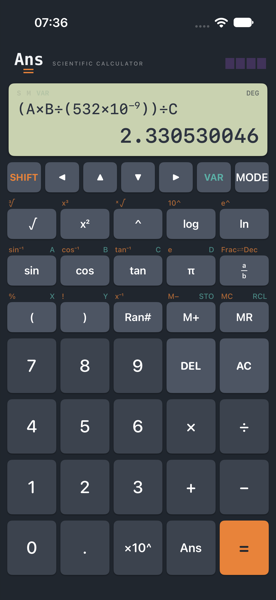
Before the eV conversion, the energy is 3.733920784 × 10⁻¹⁹ J. The wavelength is given to three significant figures, so the measured answer should be reported as 3.73 × 10⁻¹⁹ J, or 2.33 eV. The extra calculator digits are useful for the next step but are not extra experimental knowledge.
What wavelength belongs to a 3.00 eV photon?
Rearrange E = hc/λ, remembering that an energy stated in eV must be multiplied by e before it can be used with h in joule seconds:
The honest result is 413 nm, because 3.00 eV has three significant figures. It is shorter than 532 nm, which makes physical sense: E is inversely proportional to λ, so a higher-energy photon must have a shorter wavelength.
| Wavelength | Photon energy | Scale check |
|---|---|---|
| 400 nm | 3.100 eV | shorter, higher energy |
| 413.281 nm | 3.000 eV | the reversed example |
| 532 nm | 2.3305 eV | the green laser |
| 700 nm | 1.771 eV | longer, lower energy |
Read the 3 eV wavelength from the reciprocal curve
Combining the exact constants gives hc/e = 1239.841984 eV nm. If x is wavelength in nanometres, plot photon energy and the 3 eV target, set the window to x from 300 to 800 and y from 0 to 5, then choose Intersection:
f₁(x) = 1239.841984/x f₂(x) = 3
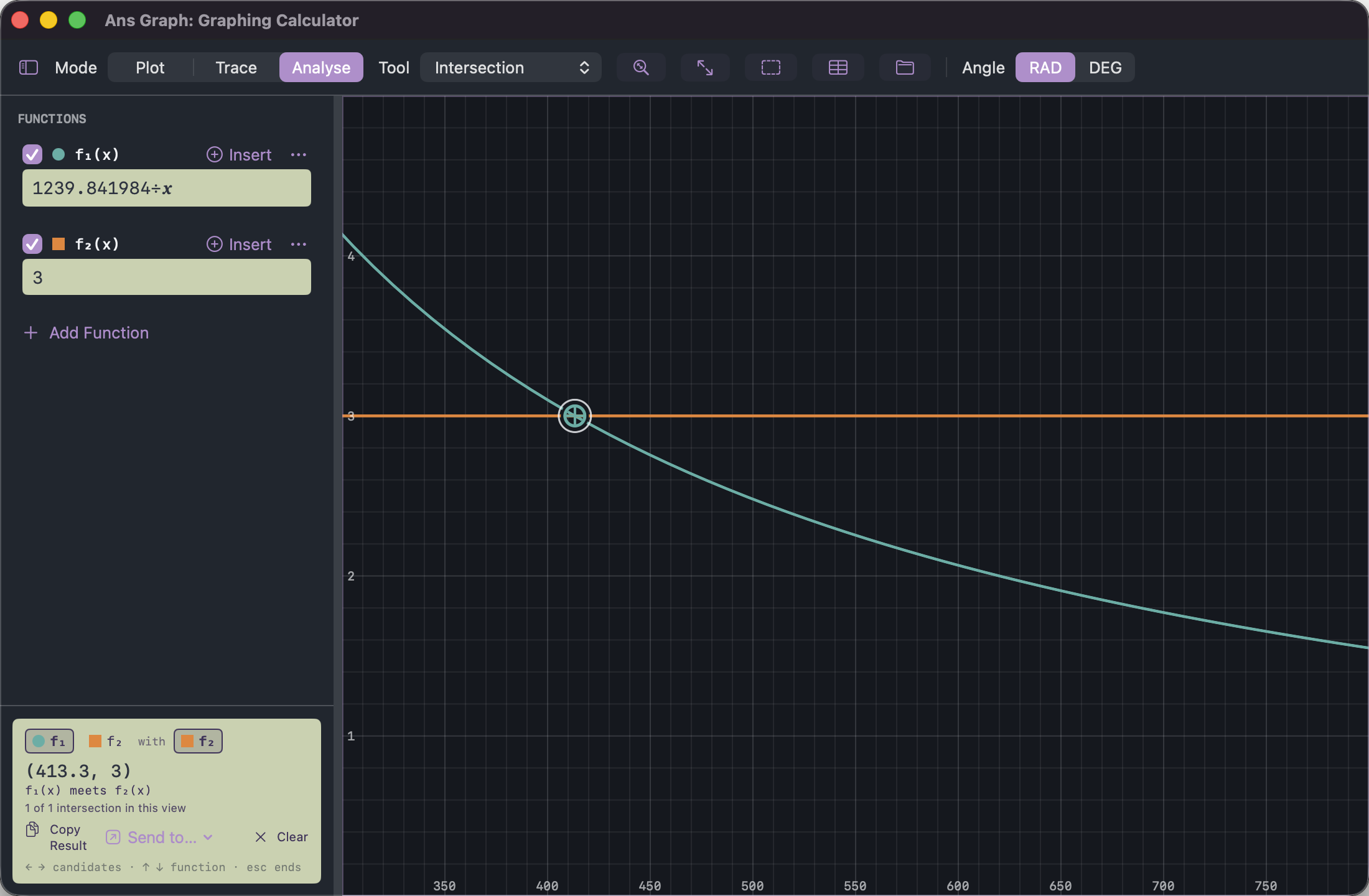
The graph adds something the single answer cannot: doubling wavelength halves photon energy, but equal additions to wavelength do not subtract equal energies. The curve is steepest at short wavelengths and flattens as wavelength grows. That reciprocal shape is why a 10 nm change matters more in the ultraviolet than in the infrared.
One photon, four linked quantities
| Quantity | Calculation | Value |
|---|---|---|
| Wavelength in metres | 532×10−9 | 5.32×10⁻⁷ m |
| Frequency | c/λ | 5.635196579×10¹⁴ Hz |
| Energy in joules | hf | 3.733920784×10⁻¹⁹ J |
| Energy in electronvolts | E/e | 2.330530046 eV |
| Reverse check | hc/(Ee), with E left in Ans | 532 nm |
What this model assumes
- The stated 532 nm is the wavelength in vacuum. Frequency does not change on entering a material, but wavelength does.
- The calculation is for one photon. Beam power is energy per unit time and needs the photon arrival rate as well.
- The light is treated as monochromatic. A real source has a finite spectral width rather than one infinitely precise wavelength.
- Planck constant, the speed of light and elementary charge use their exact SI definitions; the three-significant-figure wavelength limits the answer.
- Photon energy alone does not predict what a material will absorb, emit or transmit; that also depends on its allowed energy states.
Next: standard form on a scientific calculator for the ×10^ input behind this sum, or projectile motion for another physical model taken from formula to graph.
- Free
- No ads
- No tracking
- No account
- Every sum shown in full


Worked on Ans — a scientific calculator you can own, with reusable variables and physics constants built in, and Ans Graph, where the reciprocal relationship can be read and checked. Paid for once, with no subscription.